



The Cosmic Data Traffic Jam
Since the dawn of the space age, missions have relied on radio waves to send and receive data. While reliable, this method has a fundamental limitation: bandwidth. As our scientific instruments become more powerful, capturing breathtaking high-resolution
images and vast amounts of data, radio frequency communication struggles to keep up. For instance, sending a complete, detailed map of Mars back to Earth with current radio technology could take nine weeks. This bottleneck slows down the pace of discovery, forcing scientists to wait for crucial data and limiting the kind of information, like live high-definition video, that can be sent from missions to Mars or beyond.
A Solution Written in Light
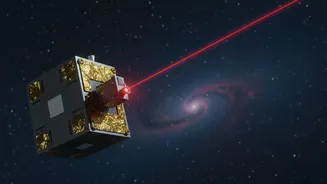
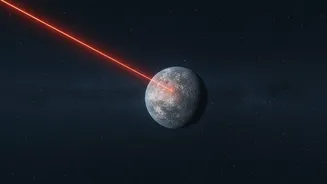
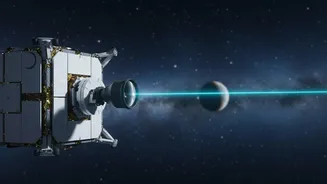
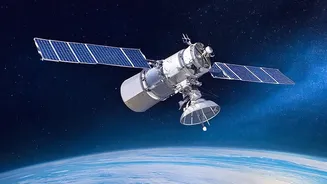
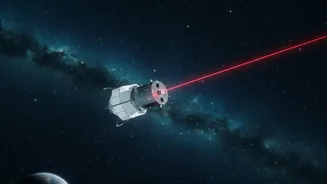
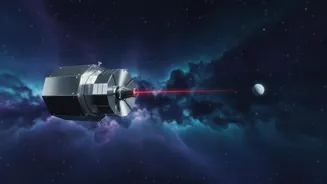
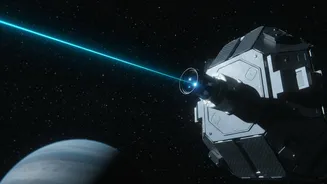
The solution is to switch from radio waves to light itself. This technology is called optical communications, or laser communications. Instead of radio antennas, spacecraft are being equipped with advanced laser transceivers. A prime example is NASA's Deep Space Optical Communications (DSOC) experiment, which launched aboard the Psyche spacecraft. This system uses a near-infrared laser to encode data and beam it across the vast emptiness of space. Because infrared light has a much higher frequency than radio waves, it can carry significantly more information in a single transmission—between 10 and 100 times more.
Encoding Data onto a Laser
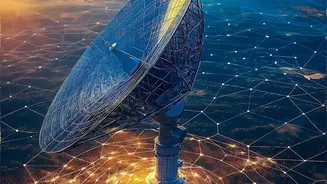
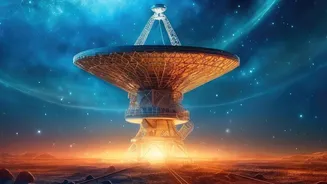
So, how does a video of a cat—which NASA famously beamed from 19 million miles away—get packed into a laser beam? The process involves encoding the data into the photons, or particles of light, that make up the beam. Think of it as an incredibly fast and sophisticated version of Morse code. The digital 1s and 0s of a video file are translated into pulses of light. The flight laser transceiver on the spacecraft fires these encoded pulses, which travel at the speed of light toward Earth. Back on the ground, massive telescopes, like the Hale Telescope at Caltech's Palomar Observatory, are used as receivers. These telescopes collect the incoming photons, which are then decoded back into the original data by highly sensitive detectors.
A Feat of Incredible Precision
One of the greatest challenges is the astonishing precision required. The spacecraft is moving, Earth is rotating, and the distance is millions of kilometers. Aiming the laser accurately is like trying to hit a moving dime from a mile away. To achieve this, ground stations first send up a powerful laser beacon. The spacecraft's transceiver locks onto this beacon to stabilise its aim, compensating for any vibrations from the spacecraft itself. It then calculates the 'point-ahead' angle, aiming the data-carrying laser not at where Earth is, but where it will be when the light arrives minutes later. Any misalignment could cause the signal to miss Earth entirely.
The Future is Faster
Successfully transmitting video and other data at high speeds from deep space marks a pivotal transformation in how we will explore the solar system. The DSOC experiment has already demonstrated download rates of 267 megabits per second (Mbps), comparable to home broadband internet. This capability will be essential for future human missions, especially to Mars. It will allow for high-definition video streaming, real-time monitoring of crew and equipment, and the rapid transmission of massive scientific datasets. Instead of waiting weeks for a map of Mars, we could receive it in just over a week, dramatically accelerating the pace of science and bringing deep space exploration closer to home than ever before.