





A World of Possibility
Located 124 light-years away, K2-18b captured global attention for its incredible potential. It’s a “super-Earth,” larger than our planet but smaller than Neptune, and it orbits its red dwarf star within the habitable zone—the temperate region where liquid
water could exist. Observations from the James Webb Space Telescope (JWST) heightened the excitement, revealing an atmosphere containing methane and carbon dioxide. These findings led to the theory that K2-18b could be a “Hycean” world: a planet with a global ocean under a hydrogen-rich atmosphere. The tantalising, though still debated, detection of dimethyl sulfide (DMS)—a gas primarily produced by marine life on Earth—made K2-18b one of the most compelling targets in the search for extraterrestrial life.
The Hunt for Technosignatures
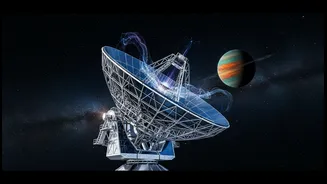
While JWST looked for biosignatures (chemical signs of life), a different kind of search began: the hunt for technosignatures. A technosignature is any measurable evidence of technology, from industrial pollution to city lights or, most famously, artificial radio signals. The underlying idea is that an advanced civilization might use radio waves for communication, just as we do. For this ambitious project, astronomers conducted an unusually powerful and coordinated survey, using two of the world's premier radio observatories: the Karl G. Jansky Very Large Array (VLA) in New Mexico and the MeerKAT telescope in South Africa. This dual-hemisphere approach provided exceptionally sensitive coverage of the K2-18b system.
A Conclusive Silence
After observing the planet and sifting through millions of potential signals, the scientific verdict is in: the team found no credible technosignatures. The process was incredibly complex, involving advanced software to filter out the overwhelming noise of human-made radio interference from Earth. Scientists used several clever techniques. For example, they used multiple telescope beams, with one pointed directly at K2-18b and others aimed elsewhere. A true signal from the planet would appear in only the main beam, while Earth-based noise would bleed across several. They also accounted for the Doppler effect; a signal from a moving planet would shift in frequency, whereas a signal originating from Earth would not. Despite the millions of hits, not a single one survived this rigorous vetting process.
What 'Nothing' Really Means
Finding nothing might sound disappointing, but in science, a null result is still a valuable result. This silence doesn’t definitively mean there is no life on K2-18b. It could mean several things: there is no technologically advanced civilization there, they don’t use radio technology we can detect, they are not broadcasting in our direction, or our telescopes are not yet sensitive enough to pick up their signals. The search allowed scientists to place an “upper bound” on the power of any potential transmitter on K2-18b. Essentially, if there is a civilization there, they aren’t shouting with anything more powerful than Earth’s strongest transmitters, like the former Arecibo Observatory.
The Search Continues, But Smarter
Perhaps the most significant outcome of this project is not the result, but the method. The sophisticated, automated filtering system developed to parse the immense volume of data is a major leap forward for the entire field of SETI (Search for Extraterrestrial Intelligence). Processing millions of signals by hand is impossible, and as new, even larger telescopes like the Square Kilometre Array come online, these proven techniques will be essential. The search for life on K2-18b is far from over. Future observations with the JWST will continue to probe its atmosphere for more definitive biosignatures. This radio silence was not a failure but a crucial step, sharpening our tools and refining our strategy in the ongoing quest to understand our place in the universe.