





Whispers from the Deep
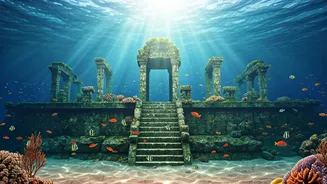
The legend of the 'Seven Pagodas' of Mahabalipuram is a story deeply embedded in Indian culture. It tells of a magnificent city with seven grand temples on the shore, six of which were claimed by the sea after provoking the jealousy of the gods, leaving
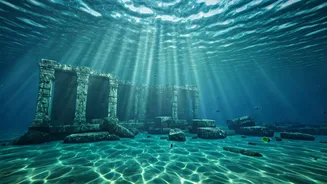
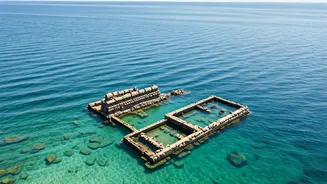
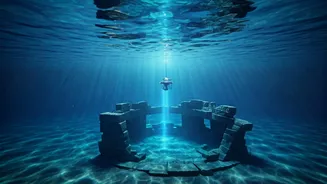
only the iconic Shore Temple standing as a solitary survivor. While early European sailors used the name 'Seven Pagodas' to identify the town, the story was largely considered a myth. However, recent and ongoing underwater explorations by organisations like the National Institute of Oceanography (NIO) and the Archaeological Survey of India (ASI) are lending new weight to these ancient tales. Using sonar and other advanced technologies, research teams have identified man-made structures, including walls, scattered stone blocks, and staircases, resting on the seabed at depths of up to 27 feet.
The Tsunami's Revelation
A pivotal moment in this underwater saga came during the devastating 2004 Indian Ocean tsunami. As the sea temporarily receded from the coastline, eyewitnesses reported seeing a long row of large granite boulders and other structures emerge from the water before being submerged once more. This event galvanised the scientific community, prompting renewed and more technologically advanced searches. Following the tsunami, the ASI and Indian Navy launched joint operations using sonar to map the seabed. Their investigations confirmed the existence of a 70-meter-long wall and remains of other temples and structures within 500 meters of the shore, corroborating what the witnesses had seen. These findings suggested that a large, complex series of buildings had indeed been swallowed by the sea.
Technology Unlocks the Past
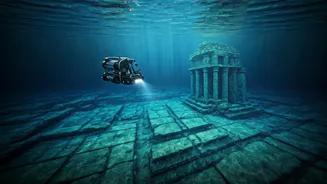
The latest chapter in this exploration involves even more sophisticated tools. The ASI's Underwater Archaeology Wing (UAW) has recently resumed its studies, equipping its team with advanced instruments like Remotely Operated Vehicles (ROVs). These ROVs can navigate challenging marine environments to capture high-resolution images and videos of the submerged remains without disturbing them. This technology is crucial because many of the structures are heavily covered in marine growth, making visual identification difficult for divers. The aim is to solve the riddle of this 7th-8th century Pallava dynasty complex that served as a landmark for sailors for hundreds of years. These efforts build on decades of work, including joint expeditions with international bodies like the UK's Scientific Exploration Society, which have consistently pointed towards a significant, man-made complex beneath the waves.
Are These the Seven Pagodas?
While the evidence for a submerged complex is compelling, the question remains: are these the fabled Seven Pagodas? The structures found are estimated to be between 1,100 and 1,500 years old, placing them in the Pallava era, consistent with the Shore Temple's construction. Some discoveries, like brick structures, could even date back to the Sangam period (300 BC - 200 AD). Radiocarbon dating of marine growth on some underwater remains has suggested submergence events as early as the first century. However, archaeologists are cautious. The structures are badly damaged and scattered, likely due to strong currents and possibly ancient tsunami-like events. Whether the findings represent a single grand city, a port, or multiple temples lost to the sea over different eras is still a subject of intense investigation. The work is not just about finding temples, but understanding the history of this ancient port city, which Tamil literature describes as a bustling hub of trade.