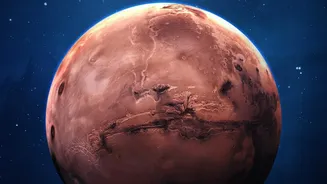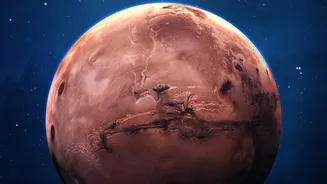





One of the greatest unsolved mysteries in our solar system hangs in the sky above Mars: where did its two small, lumpy moons come from? A daring new mission from Japan, MMX, is designed to finally find the answer.
A Tale of Two Moons
Mars has two tiny moons, Phobos and Deimos,
discovered in 1877. Unlike Earth's large, spherical Moon, they are small, irregularly shaped, and look more like potatoes than traditional satellites. Their surfaces are dark and heavily cratered, sharing characteristics with a class of primitive, carbon-rich asteroids common in the outer solar system. This resemblance led to the first major theory about their origin, but their strange orbits have kept scientists guessing for over a century. Both moons circle Mars in nearly perfect circular paths directly above the planet's equator, a feature that is hard to explain if they were simply passing asteroids snared by Martian gravity.
Theory One: The Captured Wanderers
The 'captured asteroid' hypothesis suggests that Phobos and Deimos were once asteroids orbiting the Sun, likely between Mars and Jupiter. At some point, they wandered too close to Mars and were trapped by its gravitational pull. This theory neatly explains their dark, asteroid-like appearance and composition. However, it struggles to account for their tidy, circular, equatorial orbits. Computer simulations show that capturing an asteroid typically results in a much more eccentric and inclined orbit. For Phobos and Deimos to have settled into their current paths would have required a very unlikely set of circumstances, making many scientists skeptical of this explanation on its own.
Theory Two: The Giant Impact
The second leading theory is much more dramatic: the 'giant impact' hypothesis. In this scenario, a massive object—perhaps a large planetesimal—slammed into a young Mars billions of years ago. The collision would have blasted a massive cloud of Martian rock and debris into orbit around the planet. Over time, this debris would have clumped together, or accreted, to form one or more moons. This model is similar to the leading theory for how Earth's own Moon formed and elegantly explains the circular, equatorial orbits of Phobos and Deimos. The main issue is that previous observations have suggested Phobos's composition doesn't perfectly match that of Mars's surface, leaving the mystery open.
Enter MMX: The Robotic Detective
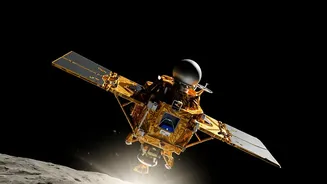
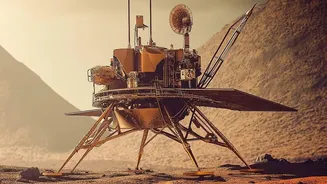
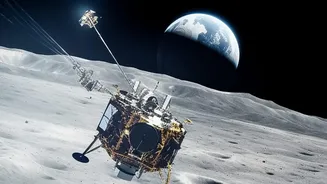
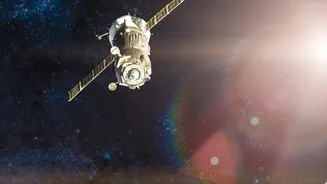
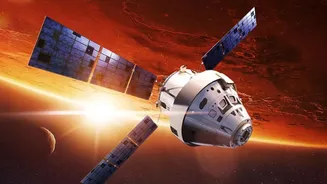
To solve this puzzle, the Japan Aerospace Exploration Agency (JAXA) has launched the Martian Moons eXploration (MMX) mission. Launched in October 2026, the sophisticated spacecraft is on a multi-year journey to the Red Planet. After arriving in August 2027, MMX will spend about three years in orbit around Phobos, mapping its surface and studying its composition with a suite of advanced instruments. The mission includes international partners like NASA, ESA, and the French and German space agencies. It will also deploy a small, microwave-sized rover named Idefix to the surface to perform on-the-ground analysis.
The Clue Is in the Sample
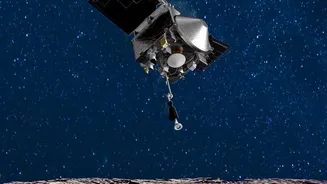
The mission's main event will be landing on Phobos—at least once—to collect a sample of its surface material, a first for any Martian moon. The spacecraft is designed to gather at least 10 grams of rock and dust using a corer and a pneumatic system that uses pressurised gas. This precious cargo will then be sealed in a capsule and sent on a long journey back to Earth, with a planned landing in Australia in 2031. Once in the lab, scientists can perform incredibly detailed analysis that is impossible with remote instruments. They will be looking for key chemical and isotopic fingerprints. If the sample's composition is a close match to meteorites from primitive asteroids, it will be a major victory for the capture theory. If, however, it is made of rock that clearly originated from Mars, it will confirm the giant impact hypothesis.