

A New Ripple on the Sun's Surface
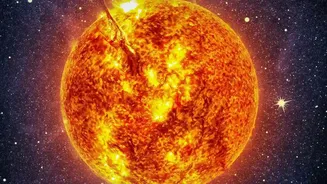
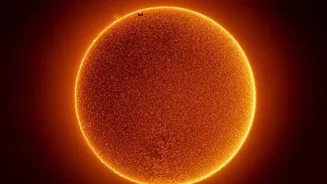
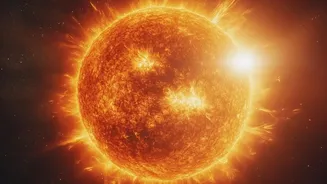
Scientists have detected a bizarre new type of wave on the Sun, and it's unlike anything seen before. Dubbed high-frequency retrograde (HFR) waves, they appear as swirling patterns, or vortices, on the Sun's surface. What makes them so strange is their
behaviour: they travel in the opposite direction to the Sun's rotation, and they move at a blistering pace—three times faster than current theories of solar physics predict is possible. This discovery was made by a team of researchers, including scientists from NYU Abu Dhabi and the Tata Institute of Fundamental Research (TIFR), who painstakingly analysed over two decades of data from space and ground-based observatories. They were hiding in plain sight within a massive dataset, waiting for the right analytical techniques to be revealed.
What Makes These Waves Different?
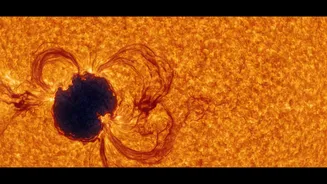
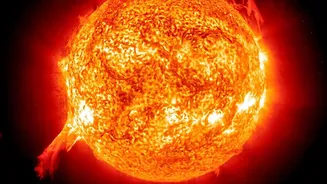
The Sun’s surface is a chaotic sea of plasma, with various waves that scientists study to learn about the star's interior, a practice known as helioseismology. For a long time, researchers have known about other types of waves, such as Rossby waves, which also move in a retrograde direction. However, these newly found HFR waves are a class apart. Not only do they travel three times faster than the well-understood Rossby waves, but their very existence challenges our fundamental models of solar fluid dynamics. Scientists initially hypothesised that the HFR waves' incredible speed might be caused by known forces like magnetism, gravity, or convection currents under the solar surface. However, the data doesn't seem to support any of these explanations, leaving researchers with a genuine mystery. The fact that they don't fit our current models is what makes them so exciting, as it points to entirely new physics at play inside our star.
Rewriting the Solar Rulebook
Since we cannot look directly into the Sun's fiery core, every piece of information we gather about its interior comes from interpreting these surface waves. They are like the seismic waves on Earth that tell geologists about the structure of our planet's core and mantle. The discovery of HFR waves means our current 'map' of the Sun's interior is incomplete. The unidentified force or process accelerating these waves suggests that the Sun’s internal dynamics are far more complex than we appreciated. This finding forces scientists back to the drawing board to develop new models that can account for such high-speed phenomena. As one researcher noted, the existence of these waves is a true mystery that may allude to exciting new physics, potentially shedding light on the otherwise unobservable solar interior.
The Earth Connection: Predicting Space Weather
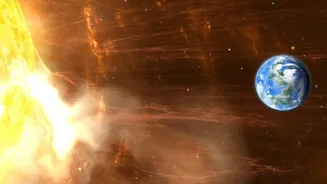
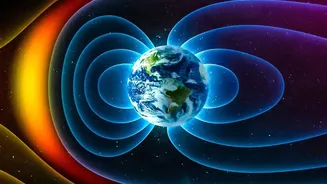
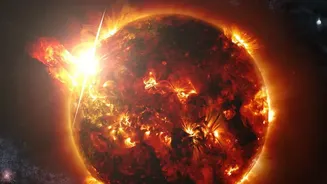
While this might seem like an abstract astronomical discovery, it has very real-world implications for us on Earth. A deeper understanding of the Sun's interior dynamics is crucial for improving our ability to predict space weather. Events like solar flares and coronal mass ejections (CMEs) are driven by the Sun's internal magnetic engine. These events hurl massive amounts of charged particles and radiation into space. When directed at Earth, they can cause geomagnetic storms that have the potential to disrupt and damage our critical infrastructure. High-energy particles can harm satellites, affecting GPS navigation, global communications, and weather forecasting. Severe solar storms can even induce currents in power grids on the ground, leading to widespread blackouts. By better understanding the fundamental physics of the Sun—a puzzle to which these new waves are a key piece—we can build more accurate models for forecasting these potentially disruptive events.