





The Golden Rule: Follow the Water
In the search for life beyond Earth, scientists operate by a simple mantra: follow the water. Liquid water is the one essential ingredient for every life form on our planet. It acts as a universal solvent, transporting nutrients and facilitating the chemical
reactions that make life possible. For decades, this principle focused the search on planets within the 'habitable zone'—the region around a star where surface temperatures allow for liquid water. But discoveries on Jupiter's moon Europa and Saturn's moon Enceladus have dramatically expanded this vision. Both are now considered 'ocean worlds,' celestial bodies with vast, hidden oceans of liquid water, making them two of the most compelling targets in the hunt for alien life.
Europa: Jupiter's Glistening, Mysterious Ocean World
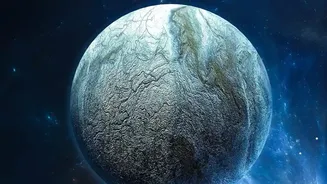
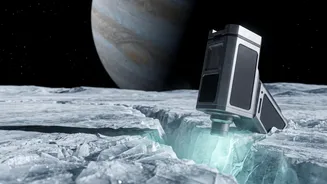
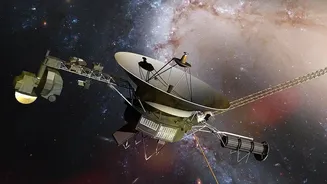
At first glance, Europa is an inhospitable ball of ice. Yet evidence gathered since the Voyager and Galileo missions strongly suggests a vast, salty ocean lies beneath its frozen shell, an ocean that could contain twice as much water as all of Earth's oceans combined. The clues are compelling: a weak magnetic field induced by Jupiter’s powerful magnetism, best explained by a global layer of conductive liquid (salt water); a young, fractured surface hinting at a dynamic interior; and Hubble Space Telescope observations of what appear to be towering plumes of water vapor erupting into space. The gravitational pull from massive Jupiter constantly squeezes and stretches the moon, generating enough tidal heat to keep its hidden ocean from freezing solid. This same process could fuel hydrothermal vents on Europa's seafloor, similar to those on Earth that support rich ecosystems in total darkness.
Enceladus: Saturn's Geyser-Spouting Moon
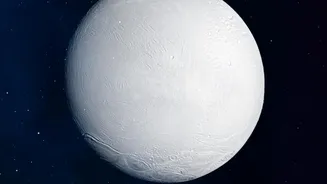
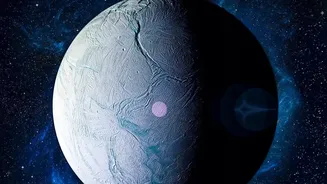
What Europa hints at, Saturn’s small moon Enceladus shows off dramatically. In 2005, NASA's Cassini spacecraft made a stunning discovery: enormous geysers erupting from 'tiger stripe' fractures near Enceladus's south pole, blasting water vapor, ice particles, and other chemicals hundreds of kilometers into space. Enceladus is, in effect, giving us free samples of its subsurface ocean. Cassini flew directly through these plumes multiple times, and its instruments detected not just water, but salt, silica dust, and complex organic molecules. Most exciting was the detection of molecular hydrogen and methane. This strongly suggests the presence of hydrothermal vents on its seafloor, where hot rock and water interact—a chemical process that provides an energy source that microbes on Earth use to thrive. This makes the moon's ocean one of the most accessible and promising habitable environments in the solar system.
Searching for Life's Telltale Signs
Scientists aren't looking for little green men. The search is for 'biosignatures'—any substance, object, or pattern whose origin specifically requires a biological process. This could range from complex organic molecules like amino acids and lipids, which are building blocks of life on Earth, to specific chemical imbalances in the atmosphere or plumes that are hard to explain through geology alone. Finding certain types of amino acids, for instance, could be a powerful indicator of life. The challenge is to ensure that a potential biosignature couldn't also be produced by non-living chemical reactions. The goal of current and future missions is to use highly sensitive instruments to analyze the composition of these worlds and hunt for these telltale clues.
The Next Wave of Cosmic Exploration
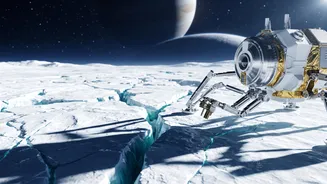
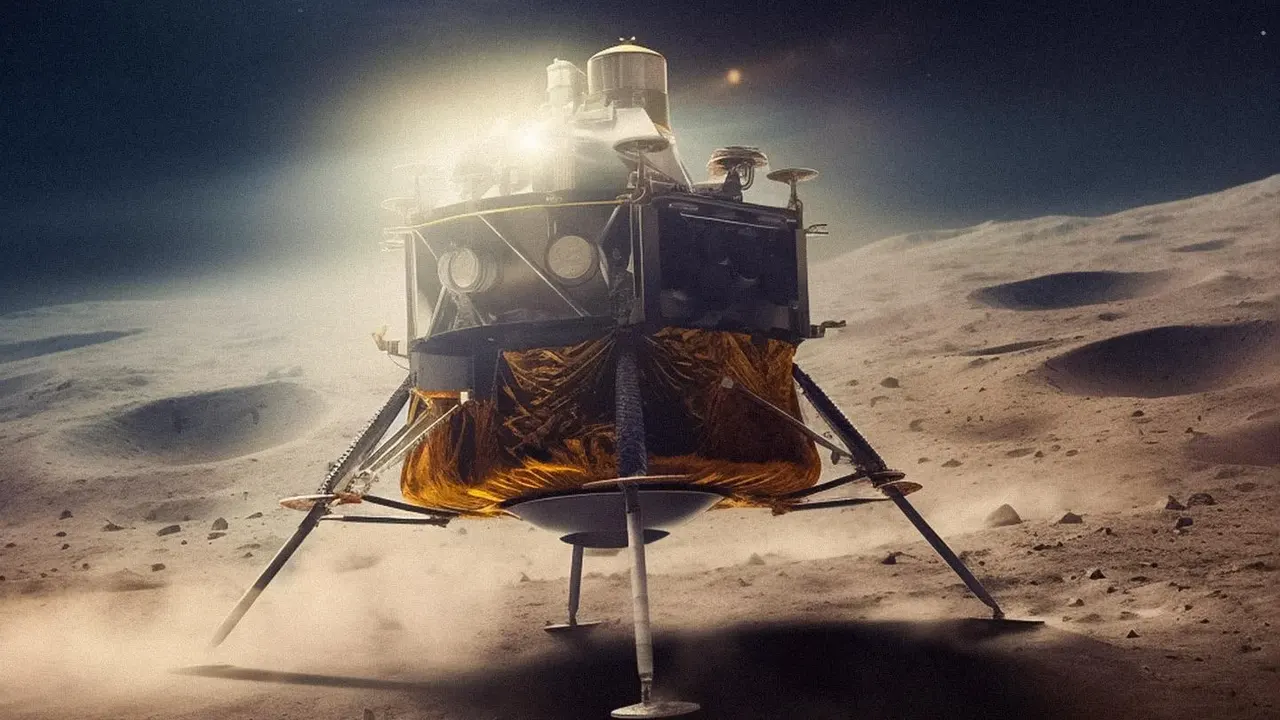
A new era of exploration targeting these ocean worlds is already underway. NASA's Europa Clipper mission, launched in October 2024, is currently en route to Jupiter. Upon arrival in 2030, it will perform dozens of close flybys of Europa, using ice-penetrating radar and spectrometers to confirm the ocean's existence, measure the ice shell's thickness, and scout for active plumes. While Clipper isn't designed to find life directly, it will characterize Europa's habitability in detail. Meanwhile, scientists are planning a return to Saturn. Both NASA and the European Space Agency (ESA) have identified Enceladus as a top priority for a future flagship mission, with proposals for an 'Orbilander' that would orbit the moon, sample its plumes, and then land on the surface to search for evidence of life directly.