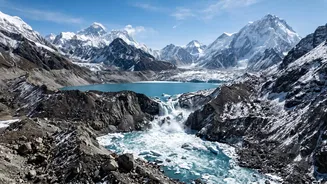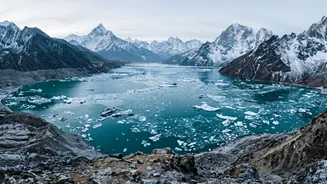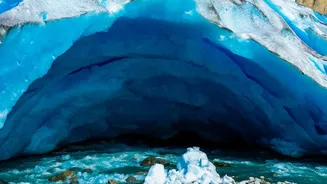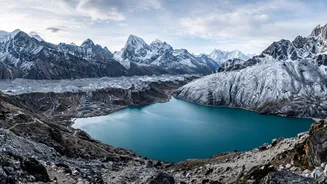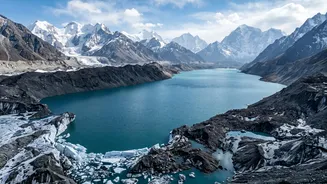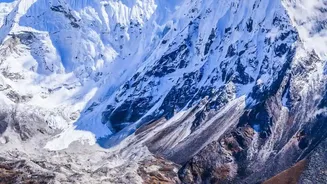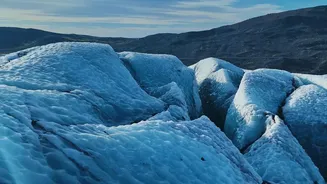






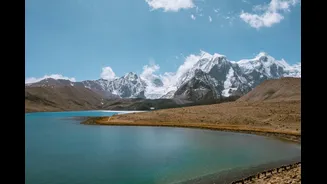
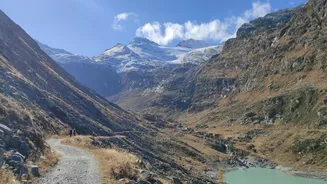
The majestic Himalayas, often called the 'Third Pole', are sending a stark warning. As global temperatures rise, its ancient glaciers are melting at an alarming rate, creating a new and devastating threat: glacial lake outburst floods.
What is a Glacial Lake Outburst Flood?
Imagine a massive
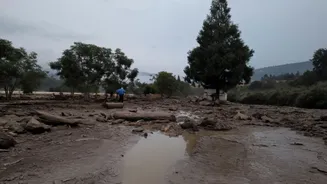
natural dam high in the mountains, holding back a vast lake. Now, imagine that dam suddenly bursting. That, in essence, is a Glacial Lake Outburst Flood, or GLOF. As glaciers retreat due to warming, they leave behind large depressions that fill with meltwater. These lakes are often dammed by unstable walls of earth and debris (moraines) left by the receding glacier. These natural dams can fail without warning due to pressure from the growing lake, an ice avalanche, a landslide, or even an earthquake. The result is a sudden, violent release of millions of cubic metres of water and debris that rushes downstream, destroying everything in its path with the force of a 'Himalayan tsunami'.
An Accelerating Threat in India's Backyard
The Hindu Kush Himalaya (HKH) region, which includes India, is warming nearly twice as fast as the global average. This has put glacier melt into overdrive. According to a landmark 2023 report from the International Centre for Integrated Mountain Development (ICIMOD), glaciers in the region disappeared 65% faster in the 2010s than in the previous decade. This rapid melting is leading to the formation and expansion of thousands of glacial lakes. A 2020 study identified 47 particularly dangerous lakes across India, Nepal, and China, but the actual number is now estimated to be significantly higher. Recent events, like the 2023 South Lhonak lake GLOF in Sikkim which claimed dozens of lives and affected 80,000 people, and a 2026 GLOF in Bhutan that triggered alerts in West Bengal and Assam, serve as tragic reminders of this growing vulnerability.
Millions in the Path of Danger
The threat is not confined to remote mountain peaks. The water and debris from a GLOF travels down river valleys that are often densely populated. A UN official warned that the population at risk 'goes into the millions'. These communities, along with vital infrastructure like roads, bridges, and hydroelectric power plants, are in the direct line of fire. The states and union territories of Ladakh, Jammu and Kashmir, Himachal Pradesh, Uttarakhand, Sikkim, and Arunachal Pradesh are particularly vulnerable. Beyond the immediate destruction, the cascading impacts could make entire riverbanks effectively uninhabitable. A UN-led study found that India has already recorded the highest number of deaths from GLOFs in the entire Himalayan region.
Beyond Floods: A Looming Water Crisis
While the immediate danger is catastrophic flooding, the long term consequences of melting glaciers are just as severe. The ice and snow of the Himalayas feed 12 major rivers and provide fresh water for nearly two billion people across Asia, including 1.65 billion downstream in countries like India. The ICIMOD report projects that water availability from glacial melt will likely peak around the middle of the century and then begin to decline sharply. With current emission trends, the region's glaciers could lose up to 80% of their volume by 2100. This poses a grave threat to water security, affecting everything from drinking water supplies to agriculture, which over 120 million farmers in the Indus, Ganges, and Brahmaputra basins depend on.
Tackling the GLOF threat requires a two -pronged approach. The first is global action to cut greenhouse gas emissions, which is the root cause of the accelerating melt. The second is immediate , on -the -ground action to protect vulnerable communities. Experts and reports from the UN and other bodies stress the urgent need for robust early warning systems. This involves using satellite imagery and on -site sensors to monitor dangerous lakes , combined with clear communication plans to evacuate downstream populations in time . India 's National Disaster Management Authority (NDMA) has identified hundreds of at -risk lakes and initiated a risk mitigation project . However , experts warn that the pace of implementation is critical , as a major GLOF could occur before all defenses are fully in place .