






A Weather Report From 280 Light-Years Away
Imagine getting a weather forecast not for another city, but for another world entirely. That's essentially what NASA's Webb telescope has done for WASP-43 b, a gas giant planet located about 280 light-years from Earth. This isn't just a simple temperature
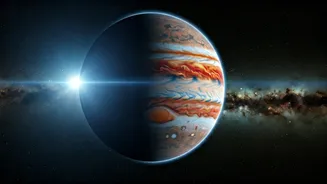
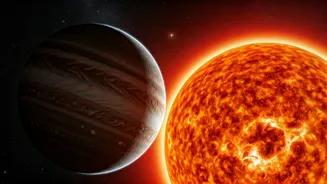
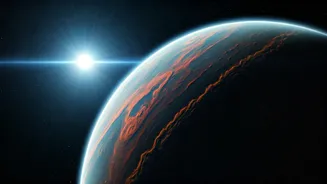
reading; it's a detailed map of the planet's climate. The findings are staggering: the planet's 'day' side, which is permanently locked facing its star, roasts at temperatures around 1,250 degrees Celsius—hot enough to forge iron. The 'night' side is cooler, but still a blistering 600 degrees Celsius. These observations mark a pivotal shift from merely detecting exoplanets to truly characterizing them as unique, dynamic worlds.
How Webb Becomes a Cosmic Meteorologist
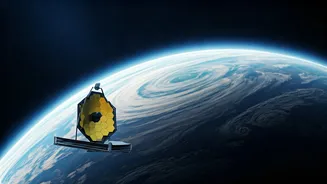
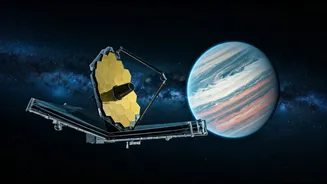
So, how does a telescope become a long-range weather station? The key is a technique called phase curve spectroscopy. As WASP-43 b orbits its star in just 19.5 hours, Webb's Mid-Infrared Instrument (MIRI) stared at the system for over a full day, measuring the tiny changes in brightness. When the scorching dayside faces us, the system is brightest. As the planet rotates to show its darker nightside before passing behind the star, the light dims. By analyzing this light across different infrared wavelengths, scientists can deduce the temperature and atmospheric composition of different parts of the planet as they roll into view. It’s like creating a 3D map of a world by carefully watching its glow.
Supersonic Winds and Clouds of Rock
The weather on WASP-43 b is far more extreme than anything in our solar system. The data revealed winds whipping around the planet's equator at a mind-boggling 8,000 kilometers per hour. These furious, supersonic winds are so fast they prevent the formation of methane on the planet’s nightside, something scientists had expected to find. The temperature difference between the two sides also points to another wild feature: clouds. But these aren't Earth's fluffy water clouds. On the cooler nightside, they are likely thick, high-altitude blankets made of minerals and vaporized rock, which trap heat below them. The dayside, by contrast, appears to be completely clear of clouds, exposed to the full, brutal radiation of its star.
A Stepping Stone to Finding Habitable Worlds
While a 'hot Jupiter' like WASP-43 b is certainly not habitable, these techniques are critical practice for the ultimate goal: finding a planet that could support life. Understanding a planet's weather is a crucial piece of the puzzle. Does it have clouds? Does it have winds that distribute heat? Does it have water vapor? Webb has already detected water vapor in the atmospheres of several exoplanets, a key ingredient for life as we know it. By perfecting these atmospheric mapping techniques on giant, hot worlds, astronomers are building the toolkit they will one day use to scrutinize smaller, cooler, rocky planets that orbit in their stars' 'habitable zones'—the region where liquid water could exist on the surface.
A New Chapter in Astronomy
Before the James Webb Space Telescope, exoplanet atmospheres were largely a mystery. Telescopes like Hubble and Spitzer gave us tantalizing hints, suggesting the presence of water vapor or clouds, but lacked the precision to paint a full picture. Webb's power and stability have changed the game, turning exoplanets from single data points into complex worlds with climates, chemistry, and weather systems. It’s the beginning of a new era of comparative planetology, where we can study the vast diversity of planets in the galaxy and, in doing so, better understand our own place in the cosmos. Each weather report from a distant world is another page in our ever-expanding encyclopedia of the universe.