






The Monsoon's Mighty March
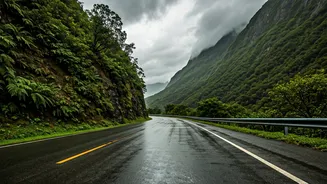
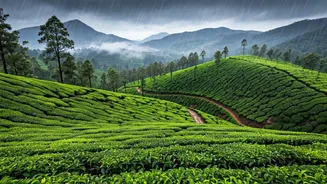
Every year, from June to September, the great Indian monsoon transforms the subcontinent. Moisture-rich winds sweep in from the Indian Ocean and the Arabian Sea, travelling north across the plains. They bring heavy rainfall that replenishes rivers, nourishes
crops, and turns the landscape a vibrant, lush green. This annual weather phenomenon is the lifeblood for much of the country, dictating agricultural cycles and filling reservoirs. The image of dark clouds and relentless rain is synonymous with this season for hundreds of millions of people. But as these clouds continue their journey northward, they encounter an obstacle they cannot cross.
The Himalayan Wall
Standing as a colossal barrier between the Indian subcontinent and the Tibetan Plateau is the Himalayan mountain range. These are not just hills; they are the tallest mountains in the world, with peaks soaring over 8,000 metres. When the moisture-laden monsoon winds reach this formidable wall, they are forced to make a dramatic ascent. They cannot go around, and they cannot go through. This forced upward movement of air is the critical first step in a process that determines the climate for the entire region, creating two vastly different worlds on either side of the range.
The Science of a Rain Shadow
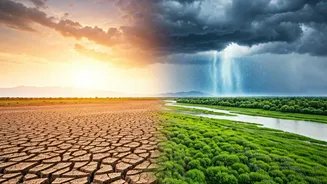
This phenomenon is known as the 'rain shadow effect,' and it's a classic geographical process. Imagine the monsoon clouds are like giant, water-soaked sponges. As the winds push them up the southern slopes of the Himalayas (the windward side), the air expands and cools rapidly. This cooling causes the water vapour to condense and form clouds, which then release their moisture as heavy rain and snow. In essence, the mountains 'squeeze' the water out of the clouds. By the time the air mass has crested the high peaks of the Great Himalayan range and the Zanskar range, it has lost almost all of its moisture.
Life on the Dry Side
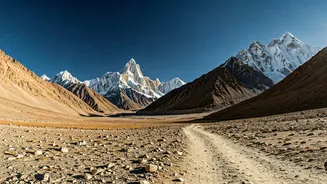
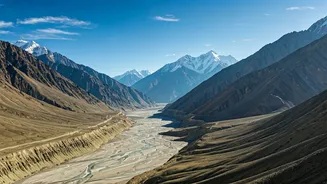
Ladakh lies on the northern, or leeward, side of these ranges. As the now-dry air descends into the valleys of Ladakh, it compresses and warms up. This warm, dry air has very little moisture left to give, resulting in minimal precipitation. While regions like Mumbai or Cherrapunji are measuring rainfall in thousands of millimetres, Ladakh receives less than 100 millimetres annually, much of it from snow in the winter. This is why Ladakh is classified as a 'cold desert'—a high-altitude arid region with stark, barren landscapes, deep blue skies, and intense sunlight, completely shielded from the monsoon's reach.
A Land Defined by Scarcity
This profound dryness has shaped every aspect of life in Ladakh. The landscape is a canvas of brown and grey mountains, with life-giving greenery found only in narrow ribbons along rivers and streams. Agriculture is not rain-fed but depends entirely on the meltwater from glaciers and winter snow that collects in the high peaks. This reliance has fostered ingenious irrigation systems, with intricate channels (known as 'yuras') that carefully guide precious water to fields of barley, wheat, and vegetables. The architecture, culture, and even the resilient spirit of the Ladakhi people are a direct adaptation to living in this beautiful but harsh rain shadow.