




The Celestial Guest List
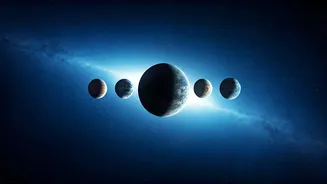
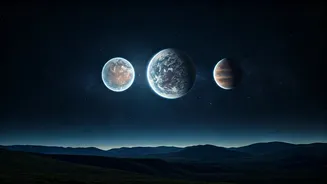
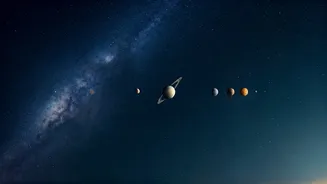
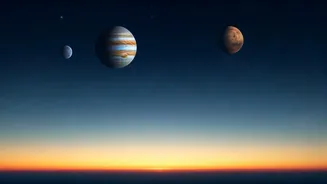
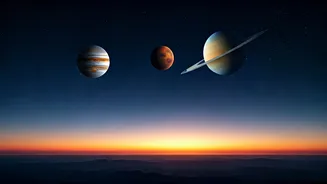
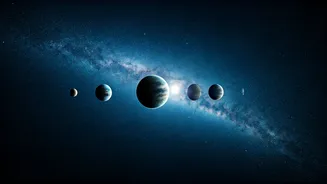
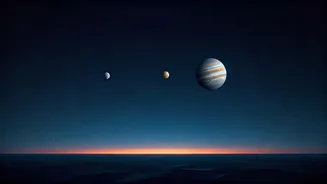
The celestial objects gracing our evening sky are none other than Jupiter, Mars, and Saturn. These aren't just any planets; they are three of the most captivating and easily recognisable members of our solar system. Jupiter, the colossal gas giant, is the largest
planet and often shines with a brilliant, steady light. Mars, the famous 'Red Planet', is notable for its distinct rusty hue, a result of iron oxide on its surface. And Saturn, the ringed jewel, is arguably the most breathtaking planet to view through a telescope, though its golden glow is easily visible to the naked eye. Seeing any one of them is a treat. Seeing all three clustered together is a truly special occasion for stargazers.
What Exactly Is a Planetary Alignment?
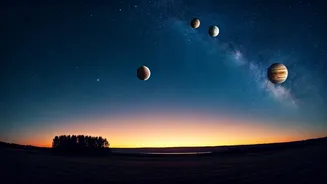
When we hear 'planetary alignment', it's easy to imagine planets forming a perfectly straight line in space. The reality is a little different but no less impressive. A planetary alignment, also known as a conjunction or appulse, is an event where two or more planets appear close to one another in our sky. It's a line-of-sight phenomenon. The planets themselves are still hundreds of millions of kilometres apart, orbiting the Sun on their own vast paths. But from our vantage point here on Earth, their orbital positions cause them to gather in the same small patch of sky. This creates the beautiful illusion of a cosmic meeting. These events are not astronomically dangerous or harbingers of doom; they are simply a beautiful quirk of orbital mechanics that we are lucky enough to witness.
How and When to See the Show
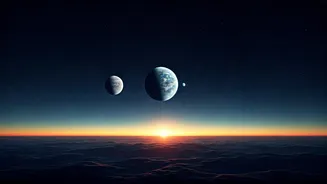
This planetary trio is best viewed in the western sky shortly after sunset. For observers in India, the prime viewing window begins about 30 to 45 minutes after the sun dips below the horizon, during the period of twilight. At this time, the sky is dark enough for the planets to become visible, but they haven't yet set. You won't need to stay up late; in fact, the show is over within a couple of hours. Look towards the west, the same direction the sun just set. The planets will appear as bright, star-like points of light that don't twinkle as much as actual stars. Jupiter will likely be the brightest and easiest to spot first, followed by Saturn and the fainter, reddish Mars.
Tips for the Best Viewing Experience
You don’t need any special equipment to enjoy this alignment, but a few simple tips can enhance your experience. First, try to get away from the bright lights of the city. Light pollution can wash out the fainter planets and the subtle beauty of the twilight sky. Even a local park or a rooftop with an unobstructed view of the western horizon will be a major improvement. Second, give your eyes about 15-20 minutes to fully adapt to the darkness. You'll be surprised how much more you can see once they've adjusted. While a telescope is not necessary, a simple pair of binoculars can dramatically improve the view. With binoculars, you might be able to spot Jupiter's four largest moons—Io, Europa, Ganymede, and Callisto—appearing as tiny pinpricks of light flanking the giant planet.
A Sight Through the Ages
As you gaze at this celestial gathering, take a moment to appreciate that people have been watching these same planets for millennia. Before we knew they were worlds of rock, ice, and gas, they were wanderers in the sky, revered as gods and used for navigation and timekeeping across ancient cultures, including in India. Jupiter, known as Brihaspati, was seen as a divine guru. Mars, or Mangala, was a warrior figure. Saturn, or Shani, was a powerful deity associated with justice and discipline. This alignment connects us not just to the vastness of the cosmos, but to a long history of human curiosity and wonder. You are seeing the same sight that inspired countless myths, poems, and scientific discoveries.