





Beyond the 'Goldilocks Zone'
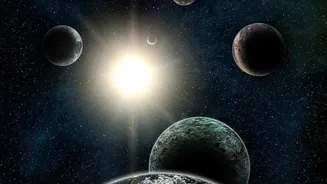
For decades, the hunt for habitable exoplanets has been guided by a simple idea: find a rocky planet orbiting its star at a distance that allows liquid water to exist on its surface. This region, nicknamed the 'Goldilocks Zone', is a useful first filter.
After all, life as we know it requires liquid water. However, being in the right place is just the beginning of the story. A planet can be in the perfect spot and still be a frozen iceball or a scorching, toxic wasteland. Factors like atmospheric pressure, composition, and even the planet's internal geology play a crucial role in determining whether water can actually flow. Scientists are increasingly looking beyond this simple metric to a more holistic view of what makes a planet a potential haven for life.
The Right Kind of Star
A planet's habitability is deeply tied to the nature of its parent star. An ideal star provides a stable, long-lived source of energy. Our Sun is a relatively calm, middle-aged star, which has allowed life on Earth billions of years to evolve. Many stars, especially smaller, cooler red dwarfs, are prone to violent flare-ups. If a planet orbits too closely to one of these volatile stars, it could be blasted with intense radiation, potentially stripping away its atmosphere and sterilising its surface. Conversely, stars much larger than our Sun burn through their fuel too quickly, not leaving enough time for complex life to potentially arise. The star must be 'just right' in its stability and lifespan.
A Protective Magnetic Shield
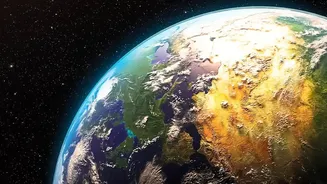
One of the most underappreciated features of Earth is its powerful magnetic field. Generated by the flow of molten iron in our planet's core, this invisible shield deflects the constant stream of charged particles from the Sun, known as the solar wind. Without it, this solar radiation would slowly erode our atmosphere, a fate that likely befell Mars billions of years ago, turning it from a potentially wetter world into the cold, dry planet we see today. For an exoplanet to retain its atmosphere—and protect any potential life on its surface from harmful cosmic rays—a planetary-scale magnetic field is considered a critical requirement. It acts as a gatekeeper, preserving the very air that makes a world habitable.
The Planet's Own Engine: Plate Tectonics
Habitability isn't just about external factors; what happens inside a planet is just as important. On Earth, the slow, constant churn of plate tectonics acts like a global thermostat. This process helps recycle crucial elements and regulate the climate over geological timescales. For instance, volcanic activity, often found at the boundaries of tectonic plates, releases gases like carbon dioxide into the atmosphere. This gas is then pulled from the atmosphere through weathering processes and sequestered in rocks, which are eventually cycled back into the planet's mantle. This carbon cycle prevents the planet from getting stuck in a runaway greenhouse state, like Venus, or a permanent deep freeze. While some scientists debate if it's an absolute necessity, there's a strong case that a geologically active planet with a process like plate tectonics is far more likely to maintain a stable, life-friendly climate for billions of years.
The Perfect Atmospheric Mix
Finally, even with all the other conditions met, a planet needs the right kind of atmosphere. It can't be too thick, like on a gas giant, or too thin, like on Mars. A planet's size and gravity play a huge role here; a planet that is too small cannot hold onto its atmosphere against the push of stellar winds. The composition is also key. It needs to contain a mix of gases that can create a moderate greenhouse effect to keep the surface warm enough for liquid water, but not so much that it boils the oceans away. It must also provide protection from UV radiation and contain the necessary chemical ingredients for life, such as nitrogen and carbon.