





Vrikshasana, or Tree Pose, is a foundational yoga posture that builds stability, strengthens your legs, and calms the mind. But the secret to unlocking its power isn't just strength; it's focus. Let's explore how to find your balance.
The Foundation of Focus: Understanding Drishti
Before lifting a
single foot, the most critical element to establish in Tree Pose is your 'drishti', a Sanskrit term for a focused gaze. This is the practice of resting your eyes on a single, unmoving point in front of you. This simple action is transformative for balance. When your gaze wanders, your mind and body tend to follow, leading to wobbles. By fixing your eyes on one spot, you provide your brain with a stable reference point, which dramatically increases your ability to stay steady and centered. This practice turns a physical challenge into a moving meditation, enhancing concentration and bringing a sense of calm.
Beginner Modification: The Kickstand
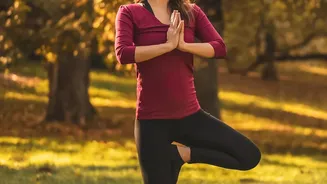
If you're new to balancing poses, or just feeling unsteady today, the 'kickstand' variation is the perfect place to start. Begin by standing tall and shifting your weight into one leg. Then, bend your other knee and place the ball of that foot on the floor, resting your heel against the inner ankle of your standing leg. This creates a stable, triangular base while still allowing you to practice the alignment of the pose. Your hands can be brought to your heart in a prayer position (Anjali Mudra) or rested on your hips. This modification builds confidence and strengthens the ankle and leg muscles without the pressure of a full balance.
The Classic Pose: Foot to Calf or Thigh
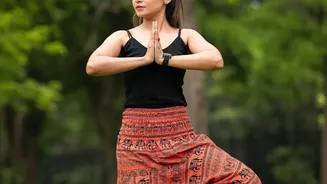
Once you feel stable in the kickstand, you're ready to lift your foot higher. From Tadasana (Mountain Pose), shift your weight to one leg. Bend the other knee and use your hand to guide the sole of your foot to either your inner calf or your inner thigh. The most important rule here is to never place your foot directly on the side of your knee, as this puts unsafe pressure on the joint. Actively press your foot into your leg and your leg back into your foot; this creates a stable connection and engages your muscles. Keep your hips level and facing forward, and lengthen your spine as if a string is pulling you up from the crown of your head.
Express Yourself: Arm Variations
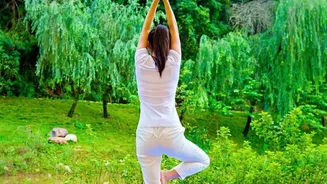
With your legs stable, you can play with different arm positions to change the feel and challenge of the pose. The most common variation is bringing the palms together at the heart. From there, you can extend your arms overhead, either parallel or with palms touching, to 'grow your branches'. This variation lengthens the spine and challenges your balance further. For a different sensation, you can extend your arms out to a 'T' shape. A more dynamic challenge involves swaying the arms like branches in the wind, which forces your core to work harder to maintain stability.
Intermediate Challenge: Half_Lotus Tree
For practitioners with open hips, the Half_Lotus Tree Pose, or Ardha Padma Vrikshasana, offers a deeper stretch. Instead of placing the sole of the foot on the inner thigh, you carefully bring the top of the foot to rest on the opposite hip crease, with the sole of the foot facing the sky. This is a significant hip opener and requires more flexibility and balance. It's crucial to approach this variation slowly and without forcing the knee joint. Keep your standing leg strong and your drishti steady to maintain your balance in this more demanding posture.
Advanced Exploration: Adding Bends and Closing Eyes
To take your Tree Pose to the next level, you can introduce movement or remove your primary balancing tool—your sight. From a stable Tree Pose with arms overhead, you can add a gentle side bend, reaching up and over to stretch the side body. Another variation is to carefully hinge at the hips and attempt a forward fold over your standing leg. The ultimate test of balance and internal awareness is to close your eyes. Without your drishti, your body must rely solely on its internal sense of stability. Try this near a wall for support, as it can be surprisingly difficult.