




Who is Anil Menon?
Dr. Anil Menon is a US Air Force lieutenant colonel, emergency physician, and NASA astronaut with deep Indian roots. Born in Minnesota to a father from India and a mother from Ukraine, his career has been nothing short of remarkable. Before being selected
as one of ten astronaut candidates from over 12,000 applicants in 2021, Menon had already built an impressive resume. He was SpaceX's first-ever flight surgeon, where he helped launch the company's first humans into space and developed the medical systems for future missions. He also served as a NASA flight surgeon, supporting crews on the ISS. His experience isn't limited to space medicine; he's been a first responder to earthquakes in Haiti and Nepal and even spent a year in India as a Rotary Scholar working on polio vaccination efforts. He graduated as a NASA astronaut in March 2024, fully qualified for spaceflight missions.
The Mission to the Space Station
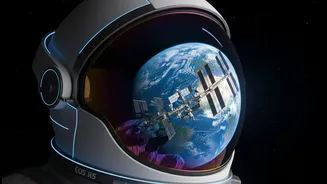
On July 14, 2026, Menon is scheduled to launch aboard a Roscosmos Soyuz spacecraft from Kazakhstan, beginning an eight-month mission on the International Space Station. As part of Expeditions 74 and 75, he will serve as a flight engineer alongside Russian cosmonauts. This long-duration stay in orbit is the culmination of years of intensive training. Life on the ISS is a continuous cycle of scientific experiments, station maintenance, and technology demonstrations in a microgravity environment. Menon's mission is slated to conclude in April 2027, after spending about 240 days orbiting the Earth.
Takeaway 1: Inspiring a Generation in STEM
For countless students and aspiring scientists in India, Menon’s journey from his family roots to low Earth orbit is a powerful source of inspiration. While India has its own celebrated space program through ISRO, seeing a person of Indian origin reach the ISS through NASA provides a tangible role model. It highlights the diverse pathways available in the fields of science, technology, engineering, and mathematics (STEM). His story underscores that a career can blend medicine, military service, and space exploration, encouraging a new generation to dream bigger and pursue careers that push the boundaries of what's possible. This kind of inspiration is a vital, practical catalyst for nurturing future talent that can contribute to India's own ambitious space goals, including the Gaganyaan human spaceflight mission.
Takeaway 2: Research with Down-to-Earth Benefits
The research conducted on the ISS has direct benefits for life on Earth, and Menon’s work will be no exception. He is tasked with conducting experiments that could have significant implications for healthcare and technology in India and worldwide. A key area of his research will be studying the physiological effects of long-duration spaceflight, such as how microgravity impacts blood flow and vein structure. He will also test technologies for producing intravenous (IV) fluids from the station's drinking water, a capability that could be revolutionary for medical care in remote or disaster-stricken areas on Earth, not just for future Mars missions. Furthermore, Menon will work on refining the in-space production of semiconductor crystals, which could lead to breakthroughs in high-performance computers and advanced medical devices.
Takeaway 3: Strengthening Global Space Collaboration
An astronaut of Indian origin flying on a US-crewed mission launching on a Russian rocket exemplifies the collaborative spirit of the ISS program. This mission reinforces the ties between global space agencies. For India, it serves as another bridge to deeper collaboration with NASA and other international partners. As ISRO plans its own space station and expands its human spaceflight capabilities, the lessons learned and relationships forged through missions like Menon's become invaluable. This international cooperation is essential for tackling the next great challenges in space exploration, such as missions to the Moon and Mars, where global partnerships will be key. Menon's presence on the ISS symbolically and practically places India within that top tier of global space collaboration.