




An Ocean That Lights Itself
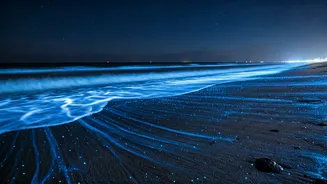
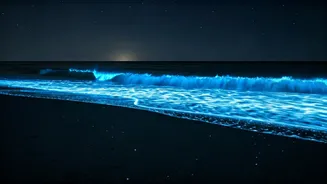
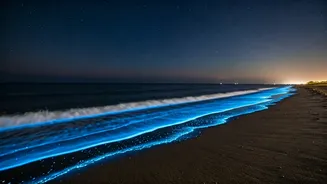
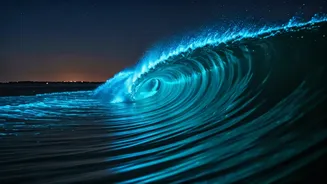
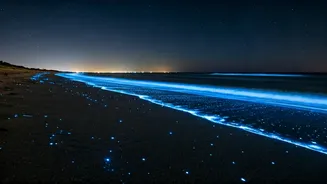
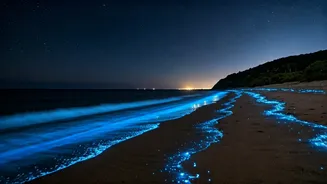
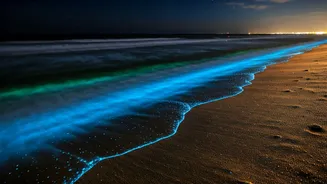
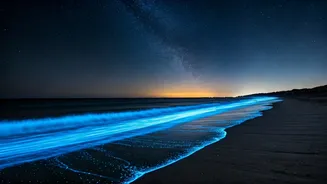
Along the coast of the southwestern Indian state of Karnataka, from Mangaluru to Udupi, a strange and magical event has been unfolding after sunset. As darkness falls, the ocean’s surf begins to emit an ethereal, neon-blue light. Every ripple, every splash
against the sand, and every boat cutting through the water leaves a ghostly, glowing trail. For photographers and local residents, it’s a spectacle straight out of a fantasy film. They gather on the beaches, tripods in hand, hoping to capture the fleeting phenomenon known as bioluminescence, or more poetically, “sea sparkle.” The images they produce are stunning: dark, moody landscapes where the only light source is the ocean itself, painting the shoreline in impossible shades of blue and cyan.
The Science of a Living Light
So, what’s behind this otherworldly glow? The answer isn’t magic, but biology. The light is produced by billions of single-celled marine organisms called dinoflagellates, specifically a species named *Noctiluca scintillans*. These plankton are a type of algae that float near the water's surface. When they are disturbed—by a breaking wave, a swimmer's kick, or the hull of a boat—they trigger a chemical reaction inside their cells. This reaction releases energy in the form of visible light, a defense mechanism designed to startle predators. It’s the same biological principle behind the flash of a firefly, but enacted on a massive, oceanic scale. The collective glow of a dense bloom of *Noctiluca* is powerful enough to illuminate entire stretches of coastline, creating the glowing waves that have captivated so many.
A Beautiful, Troubling Signal
While breathtakingly beautiful, the increasing frequency and intensity of these blooms are raising concerns among marine biologists. *Noctiluca scintillans* thrives in water with high levels of nutrients, particularly nitrogen and phosphorus. These conditions are often created by agricultural runoff and sewage discharge, suggesting the blooms may be an indicator of coastal pollution. Furthermore, while *Noctiluca* itself is not always toxic, it is a voracious predator of other essential marine life, like diatoms, which form the base of the ocean food web. When a massive *Noctiluca* bloom dies and decomposes, the process consumes vast amounts of oxygen, creating hypoxic “dead zones” where fish and other marine creatures cannot survive. So, what looks like a celestial light show on the surface could be a sign of an ecosystem under serious stress below.
The Chroniclers of the Coast
The “night sky geeks” mentioned in the headlines are more than just casual observers. They are a loose-knit community of astrophotographers, amateur scientists, and nature lovers who have become the de facto documentarians of this phenomenon. Armed with patience and sophisticated camera gear, they spend hours in the dark, experimenting with long-exposure shots to properly capture the glow’s intensity and movement. Their work, often shared on social media, serves a dual purpose. It inspires awe and wonder, bringing a remote natural event to a global audience. But it also creates a valuable visual record. By documenting when and where these blooms occur, these photographers are inadvertently contributing to a body of citizen science, providing data points that can help researchers track the changing health of the coastal ecosystem.