


Ever heard that a planet is moving 'backward'? This November, you can witness this celestial illusion yourself. It's called apparent retrograde motion, and it's one of the sky's most interesting tricks. Here’s how to see it.
What is Apparent Retrograde Motion?
First, let's clear something
up: planets don't actually stop and reverse course in their orbits. Apparent retrograde motion is an optical illusion, much like when you're in a faster car on a highway overtaking a slower one. For a moment, the slower car appears to be moving backward relative to you, even though you're both moving forward. In space, Earth orbits the Sun faster than outer planets like Mars, Jupiter, Saturn, and Uranus. Once a year, Earth's faster orbit causes it to 'lap' these outer planets. During this overtaking period, the other planet appears to temporarily reverse its direction against the backdrop of distant stars. Instead of its usual eastward drift across the night sky, it seems to slow down, move westward for a few weeks or months, and then resume its normal path. This celestial U-turn is what astronomers call apparent retrograde motion.
November’s Retrograde Performer: Uranus
While several planets go through retrograde phases, some are easier to spot than others. This November, the star of the retrograde show is Uranus. This distant ice giant began its backward journey on September 10, 2026, and will continue this apparent motion until early February 2027. This means throughout all of November, Uranus will be in its retrograde loop. Why focus on Uranus? While it’s not as bright as Jupiter or Saturn, its long retrograde period makes it a fascinating target for patient observers. Mercury and Venus are also ending their retrograde periods in mid-November, but as inner planets, their motion is much harder for beginners to track as they are often lost in the Sun's glare.
How to Actually See It
Observing retrograde motion isn't a one-night event. You won't see a planet zoom backward in a few hours. The 'movement' is only visible over weeks or even months. To see it, you need to become familiar with a patch of the night sky. First, locate Uranus using a good stargazing app. Then, note its position relative to a few nearby, fainter stars. You can even sketch the formation in a notebook. Come back to it every week or so at the same time of night. Over the course of November, you will notice that Uranus has slowly drifted westward in relation to those background stars, a direction opposite to its normal travel. That slow, steady drift is the retrograde motion in action. You're not just looking at a planet; you're observing the cosmic dance of our solar system in real time.
Your Skywatching Toolkit for India
You don't need an expensive telescope to begin your journey as an astronomer. The winter months, from November to February, generally offer some of the clearest skies in India, making it a perfect time to start. Here’s what you need:
1. A Dark Location: The most crucial element is getting away from city lights. Light pollution washes out all but the brightest objects. Head to a rural area, a national park, or a designated dark sky spot. Locations like Coorg in Karnataka or areas outside major cities offer great views.
2. A Stargazing App: Download a free app like Stellarium or SkyView. These apps use your phone's GPS to create a map of the sky above you, making it easy to identify planets, stars, and constellations.
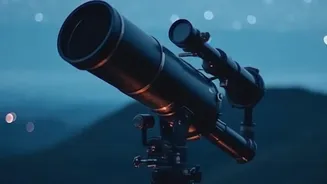
3. Binoculars: Before you invest in a telescope, a standard pair of binoculars will work wonders. They are powerful enough to make Uranus appear as a tiny, star_like point of light and will reveal craters on the Moon and the moons of Jupiter, opening up a new world of detail.
4. Patience and Comfort: Allow your eyes at least 20 minutes to fully adjust to the darkness. Bring a blanket or a comfortable chair, dress in warm layers, and have some snacks and water handy. Skywatching is a marathon, not a sprint.