


Meet the 'Warm Neptunes'
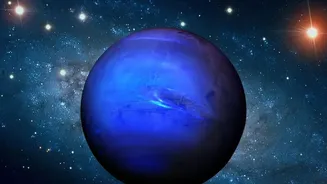
First, what exactly is a 'warm Neptune'? In our solar system, we have rocky planets like Earth and gas giants like Neptune and Jupiter. But as we look out at other star systems, we're finding planets that don't fit our local molds. 'Sub-Neptunes' or 'warm Neptunes' are
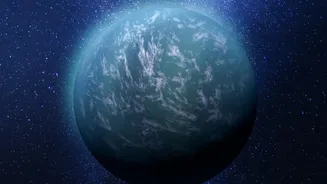
planets larger than Earth but smaller than Neptune, often orbiting incredibly close to their host stars. Take a planet like WASP-80 b, which is about the size of Jupiter but orbits its star every three days, giving it a scorching temperature. Or consider GJ 1214 b, a world shrouded in so much haze that for years, its atmosphere was a complete mystery. These planets represent one of the most common types of planets in the galaxy, yet we have nothing like them here, making them a fascinating puzzle.
The Methane Mystery
Methane is a common molecule in our solar system's gas giants. So, finding it on a distant planet isn't necessarily a shock. The surprise comes from where and in what quantity it's being found. For a planet orbiting close to its star, the intense heat and radiation should, according to many models, break methane down. For a long time, even the powerful Hubble Space Telescope struggled to detect it on many exoplanets where it was expected to be abundant. The lack of detection led to theories about carbon being depleted or photochemical reactions destroying the gas. However, the JWST is now detecting clear signals of methane on worlds like WASP-107 b, but at levels thousands of times lower than equilibrium chemistry would predict. This suggests something powerful is happening in these atmospheres—either vigorous vertical mixing is dredging up gases from the planet's hot interior, or our fundamental understanding of their atmospheric chemistry is incomplete.
A New Eye on the Cosmos
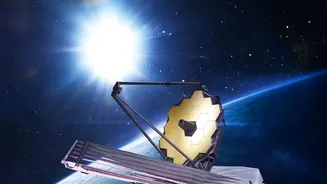
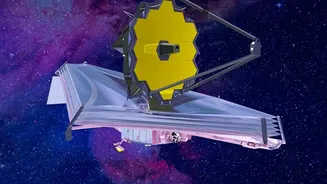
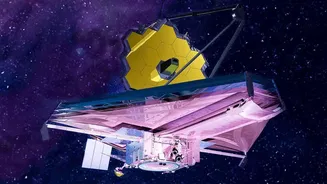
This is all possible thanks to the James Webb Space Telescope, a revolutionary piece of technology that observes the universe in infrared light. This allows it to do what previous telescopes like Hubble couldn't: peer through the thick haze and clouds that envelop many of these worlds. By analyzing the starlight that filters through a planet's atmosphere as it passes in front of its star—a technique called transit spectroscopy—JWST can identify the chemical fingerprints of different molecules like methane, water vapor, and carbon dioxide. The precision of these detections is astonishing, allowing scientists to not just spot a molecule, but to begin to measure its abundance. It's this technological leap that is turning these formerly indecipherable worlds into laboratories for planetary science.
Rewriting the Planetary Playbook
These surprising methane findings are more than just a chemical curiosity; they are forcing a rewrite of planetary formation theories. The composition of a planet's atmosphere provides crucial clues about where and how it was born. For instance, recent findings for one mini-Neptune suggest its heavy atmosphere, rich in various compounds, could only have formed far away from its star in a colder region before migrating inward. Similarly, the depleted methane on WASP-107 b provides a window into the planet's deep interior, suggesting it has a much larger, hotter core than previously thought and an incredibly dynamic atmosphere. Each new spectrum from JWST adds a piece to the puzzle, revealing a diversity of planetary systems that often defies our neat and tidy models based on our own solar system.
What It Means for the Search for Life
While the methane on these warm Neptunes is not a sign of life, this work is a crucial stepping stone in the grander search. Understanding the complex chemical and physical processes in hostile alien atmospheres is essential practice. It helps scientists refine their models so they can distinguish between methane produced by geology and methane that might be a biosignature. On Earth, methane is abundantly produced by life. JWST has even found methane on a potentially 'Hycean' (hydrogen-rich atmosphere with a water ocean) world called K2-18 b, where its presence, alongside other molecules, is tantalizing. By studying the full range of planetary atmospheres, from hot gas giants to hazy sub-Neptunes, we are learning what to look for when we finally turn our gaze to smaller, rocky, more Earth-like worlds.