

Meet S/2023 U1
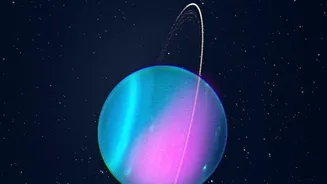
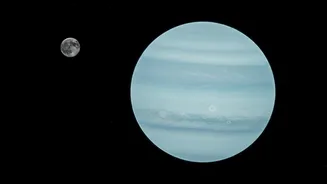
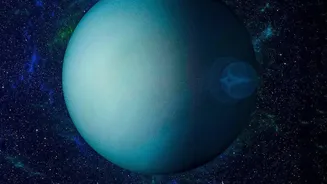
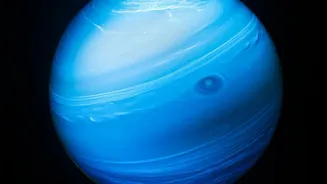
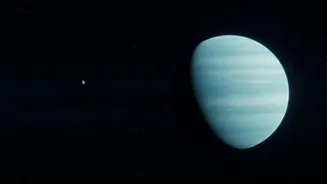
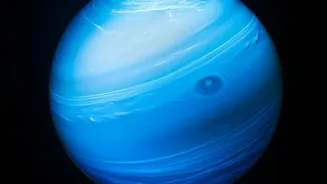
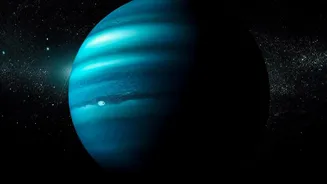
Astronomers have officially added another member to Uranus's celestial family. Provisionally named S/2023 U1, the newfound moon was first spotted in late 2023. This isn't a massive world like the planet's five major moons, such as Titania or Oberon. Instead,
it's an incredibly small object, estimated to be only about 8 kilometres in diameter, making it likely the smallest of Uranus's 28 confirmed moons. It follows a long, looping path far from the planet, taking roughly 680 Earth days to complete a single orbit. This discovery is significant as it's the first new moon found around Uranus in over two decades, a testament to the power of modern telescopes and advanced image-processing techniques.
A High-Tech Detective Story
Finding such a faint and tiny object nearly 3 billion kilometres away is a monumental task. Astronomer Scott S. Sheppard located S/2023 U1 using the powerful Magellan telescopes in Chile. The discovery was made possible through a technique called 'shift-and-add,' where many long-exposure images are layered on top of each other. By aligning the images to follow Uranus's movement, the faint moon appeared as a point of light while background stars streaked by. To confirm the orbit, Sheppard and his colleagues had to search through older data, finding traces of the moon in images taken as far back as 2021 with both the Magellan and Subaru telescopes. This painstaking work allowed them to plot its orbit and confirm it was truly a satellite of Uranus, not just a passing asteroid.
Clues to a Chaotic Past
So, why does one tiny moon matter? Its orbit and location provide crucial clues about the history of the Uranian system. S/2023 U1 is classified as an 'irregular' moon, meaning it has a distant, eccentric, and inclined orbit. Astronomers believe such moons were not formed with the planet but were captured by its gravity billions of years ago. This new moon belongs to a group of outer moons with similar orbits, including Caliban and Stephano. This orbital grouping suggests that they may all be fragments of a single, larger parent moon that was shattered by a collision with an asteroid or comet long ago. By studying these family groups, scientists can piece together the violent events that shaped the outer solar system.
Completing the Planetary Portrait
Every new discovery helps to complete our census of the solar system. The discovery of S/2023 U1 shows that Uranus, despite its sideways tilt, has a moon system that shares similarities with those of Jupiter and Saturn. All of the giant planets in our solar system have these outer collections of captured, irregular moons. Finding S/2023 U1 helps confirm that this is a common feature of planet formation and evolution. The fact that we are still finding moons around our neighbouring planets highlights how much is left to learn. These small, faint objects are the last to be discovered because they push our technology to its absolute limits, requiring special techniques to even be seen.