

A Tale of Two Poles
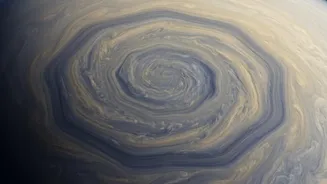
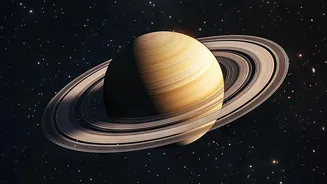
Saturn’s poles are home to two very different, yet equally fascinating, atmospheric phenomena. The north pole is dominated by the hexagon, a colossal cloud pattern with sides approximately 14,500 kilometres long—wider than the diameter of Earth. This
structure is a jet stream of atmospheric gases moving at over 320 kilometres per hour. It was first spotted by the Voyager mission in the early 1980s and has been observed for decades, indicating incredible stability. Meanwhile, Saturn's south pole features a more conventional, yet still immense, polar vortex. This circular super-hurricane has a distinct eye, similar to cyclones on Earth, but is vastly larger and more powerful. Unlike the hexagon, the southern vortex is a singular, massive cyclone. The stark difference between the two poles suggests that varying atmospheric conditions and seasonal effects play a significant role in how these patterns form and sustain themselves.
The Engine of the Hexagon
So, what creates such a perfect geometric shape on a gas giant? The leading theory points to a phenomenon known as a standing wave. Scientists believe the hexagon is formed by a powerful eastward jet stream that gets perturbed, causing it to meander into a stable, six-sided shape. Experiments at Oxford University have shown that when a circular tank of liquid is rotated at different speeds at its center and periphery, regular shapes, including hexagons, can form in the turbulent area between the flows. On Saturn, steep differences in wind speeds within the atmosphere likely create this effect. The jet stream essentially becomes pinched by surrounding smaller vortices, forcing its path into a polygonal shape. The pattern appears stationary because the wave itself moves at the same speed as Saturn's own rotation, locking it in place relative to the planet.
The Power of Deep Convection
The longevity of these patterns is another puzzle. On Earth, storms and jet streams are disrupted by friction with landmasses and oceans. Saturn, being a gas giant, has no solid surface to break up these massive weather systems. This allows storms to rage for incredibly long periods. Recent studies suggest that megastorms, which occur every 20 to 30 years, have after-effects that can last for centuries. These powerful storms churn up ammonia from deep within the planet's atmosphere, altering its composition and leaving chemical signatures that persist long after the visible storm has faded. It's believed this deep convection—the transport of heat from the planet's interior—is a key driver of the planet's atmospheric dynamics, providing the energy needed to sustain features like the polar vortices and the hexagon for decades or even centuries.
Why They Endure
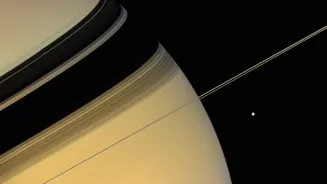
The stability of Saturn's polar patterns is also linked to the very structure of its atmosphere. The polar vortices at both poles are hot spots, warmed by air moving toward the poles, compressing, and heating up as it descends deep into the atmosphere. This process is intrinsic to the planet and doesn't depend on sunlight, which explains why a hot vortex was found at the north pole even during its long, dark winter. Data from NASA's Cassini mission, particularly during its 'Grand Finale' dives, revealed that Saturn's atmospheric motions extend thousands of kilometers deep. This immense depth gives these weather systems incredible inertia. Small cyclones that form in Saturn's atmosphere merge as they are driven toward the poles, creating a single, powerful vortex that can last for an exceptionally long time.