








More Than a Spellchecker
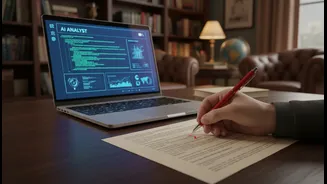
The new student habit isn't about asking an AI to write an essay from scratch. Instead, it’s an iterative process of refinement. Students are writing their own drafts and then feeding them to AI tools like ChatGPT, Grammarly, or specialized academic platforms
for feedback. This goes far beyond basic grammar and spell-checking. Today's AI assistants can suggest ways to improve sentence structure, enhance clarity, strengthen arguments, and even check for a consistent tone. Some students use these tools to generate reverse outlines, allowing them to see if their paper's structure is logical. It’s like having a 24/7 writing tutor that provides instant, non-judgmental feedback on everything from a single sentence to the entire draft.
From Rough Draft to Refined Essay
From a student's perspective, the benefits are clear. The process can significantly speed up the often tedious editing phase. For students who are not native English speakers, AI tools can be invaluable for polishing language and ensuring their ideas are communicated clearly, helping to level the academic playing field. They can also serve as a guide for understanding complex topics or finding supporting evidence for their arguments. Many students report that using AI this way helps them feel more confident in their final submission. One study found that AI assistance significantly improved writing quality, particularly in areas of linguistic precision and logical structure. Students are using the tools to refine their own ideas, not to replace the act of thinking itself.
The Educator's Dilemma
While students embrace these new tools, educators are navigating a complex new reality. The core concern revolves around academic integrity and authenticity. If a paper is heavily polished by an AI, how much of it is the student's own work? Faculty express near-universal concern that overreliance on AI could undermine the development of critical thinking and original writing skills. A 2025 survey found that 74% of college faculty believe students are using AI to write or paraphrase their essays. This has led many universities to hastily develop policies, which often vary from a complete ban to allowing AI for limited uses like brainstorming or grammar checks, provided it is disclosed. Many instructors feel they lack clear institutional guidance on how to manage this technological shift in their classrooms.
The Polished Paper Paradox
This leads to a central paradox: AI can indisputably help produce a more 'polished' final product. Papers submitted after an AI review are likely to have fewer grammatical errors and more sophisticated sentence structures. However, educators worry that this polish comes at a cost. The struggle of finding the right words and structuring an argument is a fundamental part of the learning process. Over-reliance on AI might prevent students from developing their own unique authorial voice and the analytical skills that come from grappling with complex ideas. Some studies suggest a correlation between high AI dependency and a decline in critical thinking, as students may become passive acceptors of AI suggestions rather than active writers. The result could be a generation of students who can produce flawless text but struggle to formulate an original thought.
Adapting to an AI-Assisted Future
Rather than an outright ban, a growing number of educators are looking for ways to adapt. The focus is shifting from trying to detect AI use to teaching students how to use it responsibly and ethically. Some instructors are designing assignments that are harder to complete solely with AI, such as tasks requiring personal reflection or in-class writing components. Others are actively incorporating AI into their curriculum, teaching students how to critically evaluate AI-generated suggestions and use them as a tool for deeper learning, not as a shortcut. The goal is to prepare students for a future where AI will be a common workplace tool, making AI literacy a crucial skill in itself.