





A New Blueprint for the Red Planet
For decades, space exploration was the exclusive domain of national governments. The new model, however, sees NASA acting more like an architect and anchor client than a sole builder. The agency defines the scientific goals, provides high-value instruments,
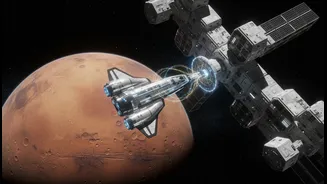
and offers its deep reservoir of expertise. In return, commercial partners like Relativity Space are tasked with developing, launching, and operating the missions. This approach was recently highlighted with the announcement of the Aeolus mission, scheduled for 2028. Under this partnership, NASA provides the advanced atmospheric-science instruments, while Relativity Space is responsible for the rocket, spacecraft, and mission operations to get them to Mars. This strategy mirrors the success of the Commercial Crew and Cargo programs that resupply the International Space Station, which dramatically lowered costs and stimulated a competitive commercial launch market.
The Compelling Case for Collaboration
The primary drivers for this shift are speed, innovation, and cost-effectiveness. By leveraging private investment and agility, NASA can conduct more science more frequently. A purely government-funded human mission to Mars has been estimated to cost hundreds of billions, if not over a trillion, dollars, a figure that is politically and fiscally challenging. Public-private partnerships allow the financial burden to be shared. Commercial companies, driven by competition, can often innovate faster and more efficiently, developing new technologies from reusable rockets to advanced spacecraft. This allows NASA to focus its resources on its core mission: pioneering science and long-term exploration goals, rather than managing the logistics of getting to orbit. As NASA Administrator Jared Isaacman stated, these partnerships act as a "force multiplier for science."
From Low Earth Orbit to Deep Space
Applying this model to Mars is a significant escalation. A mission to the Red Planet is exponentially more difficult than a trip to the space station. The distances are immense, the timelines are years long, and the technological hurdles—from life support to radiation shielding—are formidable. However, the Artemis program, which aims to establish a sustainable human presence on the Moon, is the crucial proving ground for this deep-space partnership model. Through initiatives like the Commercial Lunar Payload Services (CLPS), NASA is already contracting private companies to deliver scientific instruments to the lunar surface. These missions serve as a vital dress rehearsal, allowing both NASA and its partners to manage the complexities of deep-space operations before taking the much larger leap to Mars.
Striking a Delicate Balance
Despite the benefits, this model is not without its challenges and risks. A key responsibility for NASA is to ensure that stringent safety and performance standards are met, as the agency remains ultimately accountable for mission success and crew safety. There is also the inherent tension between public goals and commercial interests. NASA's objective is scientific discovery and exploration for the benefit of humanity. A commercial company, while sharing that vision, must also answer to investors and seek profitability, which could lead to conflicts over mission priorities. What happens if a commercial partner faces financial difficulty or fails to deliver? These are the critical questions that must be addressed. The Artemis Accords provide a framework for this, outlining principles for transparency, resource utilization, and safety to guide private enterprise in space.
The Dawn of a New Space Economy
Ultimately, the significance of NASA's public-private Mars model extends far beyond a single planet. It represents a fundamental restructuring of how humanity will approach large-scale exploration. By fostering a robust commercial space ecosystem, this model is laying the groundwork for a future where access to space is more common and affordable. This could unlock new markets in everything from asteroid mining to in-space manufacturing and tourism. The partnerships being forged today for the Moon and Mars are not just about reaching new destinations; they are about building a sustainable economic sphere that extends into the solar system, blending public ambition with the power of commercial execution to accelerate our shared future in space.