




A New Set of Eyes on the Cosmos
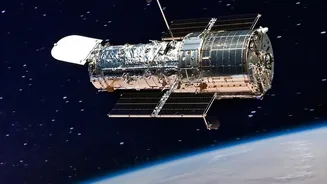
For decades, our view of the cosmos was defined by what telescopes like Hubble could see, primarily in visible and ultraviolet light. While revolutionary, this approach had a fundamental limitation: vast clouds of interstellar gas and dust blocked the view,
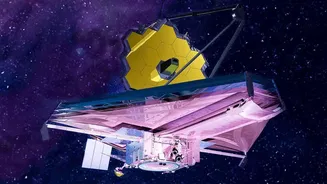
shrouding huge portions of galaxies in mystery. Enter the era of advanced infrared astronomy, spearheaded by observatories like the James Webb Space Telescope (JWST). These instruments are engineered to detect infrared light, a wavelength that the human eye cannot see but which we can feel as heat. This technological leap is akin to gaining a new sense, allowing astronomers to see what was previously hidden.
Peering Through the Cosmic Veil
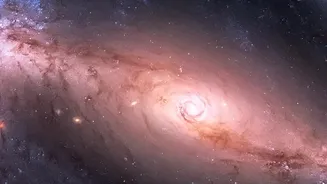
So, why is infrared the key? It comes down to physics. Visible light, which has a shorter wavelength, tends to scatter when it hits tiny particles of cosmic dust. Infrared light, with its longer wavelength, can pass through these dusty curtains much more easily, similar to how radio waves pass through walls. This means that where Hubble saw an opaque cloud of dark dust, JWST can see right through it to the stars and structures forming within. It’s not just about seeing through dust; it’s also about seeing back in time. As the universe expands, light from the most ancient and distant galaxies gets stretched out. What might have started as visible light billions of years ago arrives at our telescopes today as faint infrared glows, which only observatories like JWST are sensitive enough to catch.
What We Can Now See
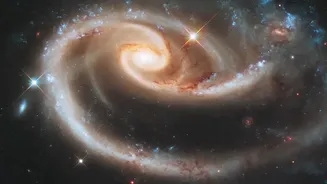
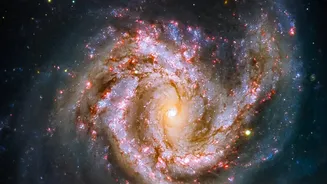
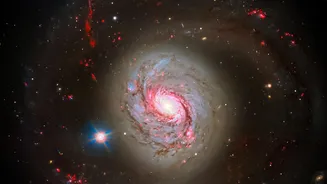
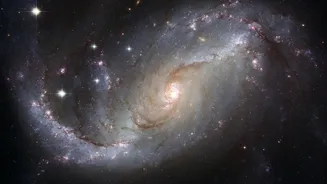
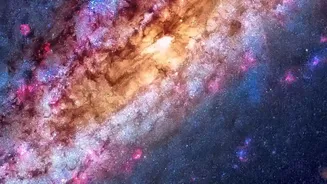
The results have been nothing short of spectacular. Recent observations of 19 nearby spiral galaxies, part of a large project called PHANGS, have revealed intricate structures of gas and dust with unprecedented clarity. Astronomers can now see glowing dust filaments, millions of individual stars, and enormous, cavernous holes in the interstellar medium, likely carved out by exploding stars. These images provide crucial clues about how galaxies build, maintain, and eventually stop their star formation processes. It’s like finally getting the full architectural blueprint for cities of stars, showing not just the bright lights but also the hidden plumbing and infrastructure. By studying these nearby galaxies in such detail, astronomers can better understand the structure of our own home, the Milky Way, which is difficult to study from our position within it.
Rewriting the Story of the Early Universe
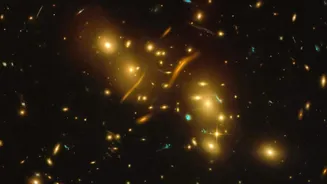
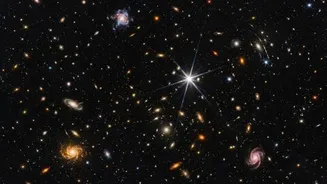
Beyond our local galactic neighbourhood, these new capabilities are transforming our understanding of the universe's infancy. Astronomers are finding galaxies in the early cosmos that are surprisingly mature and complex, challenging previous models of how quickly these structures could form after the Big Bang. Recent studies have revealed surprisingly luminous galaxies just a few hundred million years after the universe began, forcing a rethink of how efficiently the first stars and galaxies were built. These powerful telescopes are not just taking prettier pictures; they are providing the raw data that forces scientists to question and refine our fundamental theories about cosmic history, from how galaxies grow to the very nature of dark matter.