
The Dazzling Star That Isn't a Star
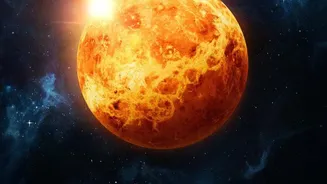
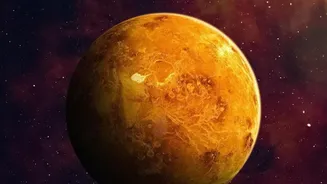
Venus is often called the 'Morning Star' or 'Evening Star', but it isn't a star at all. It's a planet, the second from the Sun, and it's the brightest natural object in our night sky after the Moon. So, why is it so bright? Venus is covered by a thick,
highly reflective layer of clouds that bounce a huge amount of sunlight back into space, making it shine like a celestial beacon. Unlike stars, which generate their own light, Venus is a brilliant mirror reflecting the Sun's glory. Its incredible luminosity means it's often the first point of light to appear after sunset or the last to fade before sunrise.
When and Where to Look in August 2026
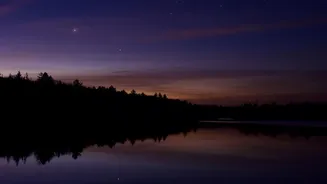
Timing and direction are everything. Throughout late August 2026, Venus is gracing our skies as a spectacular 'Evening Star'. This means you should look towards the west, in the same direction the Sun has set. The best time to spot it is during twilight, roughly 30 to 45 minutes after sunset. As the sky darkens, Venus will emerge as an unmistakably bright point of light, low on the western or west-southwest horizon. You can't miss it; its brightness easily cuts through the evening glow. In late August, you may also spot the bright star Spica near Venus, as the planet moves closer to it for a conjunction in early September.
Your Simple Step-by-Step Guide
Ready to find it? First, find a good viewing spot. An open area with a clear, unobstructed view of the western horizon is ideal. Think parks, terraces, or even a window that faces the right direction, away from the worst of city light pollution. Second, give your eyes time to adjust. Step away from your phone and bright indoor lights for at least 10-15 minutes to let your night vision kick in. Third, look west. Scan the horizon in the area where the sun went down. Venus will be the brightest object you see there, shining with a powerful, unwavering light. It's so bright, in fact, that it can often be spotted even from light-polluted urban areas.
Is It Venus, a Star, or a Plane?
For a beginner, it can be tricky to tell celestial objects apart. Here's a simple test. Stars, even bright ones, tend to twinkle. This is because their distant, point-like light is distorted by Earth's atmosphere. Venus, being a much closer planet, appears as a tiny disc, so its light is stable and doesn't twinkle. What about airplanes? An airplane's lights will blink, and you'll notice it moving steadily across the sky over a few seconds or minutes. Venus, while it moves night after night, will appear stationary during a single viewing session. If it’s incredibly bright, doesn't twinkle, and isn't moving, you've found Venus.
Shukra: The Planet's Place in Indian Culture
In India, Venus is known as Shukra and holds deep cultural and astrological significance. In Hindu mythology, Shukracharya is the revered guru of the Asuras (demons), a master of wisdom, and the possessor of the secret to reviving the dead. As a planetary body, or 'graha', in Vedic astrology, Shukra governs aspects of life such as love, beauty, wealth, and creativity. The day Friday is even named 'Shukravar' in his honour across many Indian languages. So when you gaze upon that brilliant point of light, you're not just seeing a neighbouring planet; you're connecting with a figure deeply woven into the fabric of Indian tradition and mythology.