


Sailing on Sunlight
The concept of a solar sail sounds like something from science fiction, but its foundation is pure physics. Light, in the form of photons, has no mass but it does have momentum. When countless photons from the sun strike a large, reflective surface—a
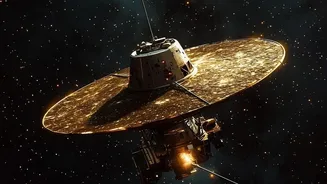
solar sail—they transfer a tiny amount of momentum, giving the spacecraft a gentle but continuous push. Think of it less like a powerful rocket engine and more like a steady, unending breeze pushing a sailboat across the ocean. While the initial force is small, it is constant. Unlike a chemical rocket that burns its fuel in a short, powerful burst and then coasts, a solar sail can accelerate for the entire duration of its journey, potentially reaching speeds impossible for conventional spacecraft.
The Advantage of Traveling Light
The biggest constraint in space mission design is weight, and most of that weight is fuel. By eliminating the need for conventional propellant, solar sails unlock a host of new possibilities. Missions can be lighter, which means they can be launched on smaller, less expensive rockets. The continuous, low-thrust propulsion allows spacecraft to achieve unique orbits that would otherwise be unstable or require massive amounts of fuel to maintain. This could enable new types of missions, like stationing a solar storm warning satellite closer to the sun than currently possible, giving Earth more advanced notice of potentially damaging space weather. It opens the door for long-duration missions to the outer solar system or even, one day, to other stars.
The Latest Test: NASA's ACS3 Mission
The latest chapter in this technology is being written by NASA's Advanced Composite Solar Sail System, or ACS3. Launched in April 2024, the mission is designed to test critical new technologies in low-Earth orbit. After an initial checkout phase, the toaster-oven-sized spacecraft successfully unfurled its massive sail, which spans about 80 square meters (860 square feet)—roughly the size of a small apartment. The key innovation being tested is its lightweight composite booms. Made of a flexible carbon fiber polymer, these booms are 75% lighter than previous metal designs and are far more resistant to warping in the extreme temperatures of space. These booms are crucial, as they are what pull the delicate sail taut and keep it stable.
Learning From a Tumble
The ACS3 deployment was a major success, but not without its challenges—providing invaluable data for future designs. After the sail unfurled, onboard cameras revealed a slight bend in one of the four booms, likely occurring as the sail was pulled taut. The spacecraft also began a slow tumble, a dynamic that mission operators had anticipated and for which they deactivated the attitude control system during deployment. Far from being a failure, these events are a critical part of the test. Mission teams are currently analyzing the data to understand the boom's performance and are working to reorient the spacecraft to better face the sun. They predict the slight bend will not prevent the mission from its next phase: using the sail to actively maneuver and change its orbit, the ultimate proof of the technology's viability.
The Future of Deep Space Exploration
The data gathered from ACS3 will directly inform the design of even larger and more capable solar sails. Follow-on technologies could enable sails up to 2,000 square meters, about the size of a basketball court, capable of propelling more complex science missions. These future spacecraft could be used for near-Earth asteroid reconnaissance, carrying payloads to study distant worlds without the tyranny of fuel limitations, or serving as communications relays for crewed missions to Mars and beyond. While solar sailing is not a replacement for the powerful chemical rockets needed to leave Earth's gravity, it represents the most promising technology for efficiently and affordably exploring the vastness of the solar system once we are there.