





The Challenge with Traditional Solar
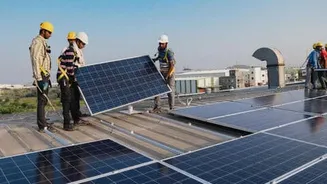
Traditional solar panels, most often made from crystalline silicon, have a well-known limitation. They are at their best when soaking up direct, bright sunlight. On cloudy days, their output drops significantly because the silicon is less effective at converting
scattered, or diffuse, light into electricity. While modern monocrystalline panels can still produce 10-25% of their rated power under heavy clouds, the dependency on clear skies remains a fundamental hurdle for a technology meant to power the world. This is especially relevant in regions with long monsoon seasons or frequent overcast weather, where grid consistency is a major goal.
The New Era of Light-Harvesting Materials
The breakthrough comes from a new class of materials that are far more versatile than silicon. The two most prominent are perovskites and organic photovoltaics (OPVs). Perovskites are a class of materials with a specific crystal structure that is exceptionally good at absorbing light. They can be 'tuned' by changing their chemical composition to absorb different parts of the light spectrum, making them ideal for various conditions. OPVs, on the other hand, use carbon-based organic molecules to capture light, making them lightweight, flexible, and suitable for manufacturing with printing-like techniques. Both represent a major shift from the rigid, heavy silicon panels we are used to.
How They Work in Low Light
So, how do these materials pull energy from a dim room or a grey sky? It comes down to a property called the 'band gap', which is the minimum energy required to excite an electron and generate current. Silicon has a fixed band gap optimized for the bright solar spectrum. Perovskites and OPVs, however, have tunable band gaps. Scientists can engineer these materials to be highly sensitive to the wavelengths of light common in indoor or cloudy environments. For instance, researchers have developed perovskite cells with efficiencies over 38% under standard office lighting, far surpassing what silicon can do in the same conditions. These materials are simply better at catching the low-energy, diffuse light that traditional panels miss.
Beyond the Rooftop: A World of Applications
This innovation unlocks applications that were previously science fiction. Because materials like perovskites and OPVs can be made thin, flexible, and even semi-transparent, they can be integrated almost anywhere. Imagine windows that generate electricity, laptop bags that charge your devices, and buildings wrapped in a power-generating skin. More immediately, this technology is perfect for powering the billions of small devices that make up the 'Internet of Things' (IoT). Instead of relying on batteries that need constant replacement, sensors, smart watches, and electronic labels could be perpetually powered by ambient indoor light.
The Road to Commercial Reality
While the potential is immense, there are hurdles to overcome before these new solar cells are everywhere. The primary challenge for perovskites has been stability; early versions degraded quickly when exposed to moisture and heat. However, recent breakthroughs in 2026 have dramatically improved their durability, with new formulations retaining over 98% of their efficiency after extensive stress testing. Another promising approach is the tandem solar cell, which stacks a perovskite layer on top of a traditional silicon cell. This hybrid design captures a wider spectrum of light, with the perovskite layer grabbing high-energy light and letting the rest pass through to the silicon below, pushing certified efficiency records past 34%. As manufacturing scales up and long-term field data becomes available, these advanced materials are poised to make solar power more reliable and ubiquitous than ever before.