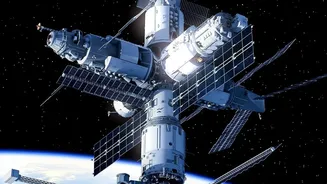






The Inflatable Advantage
When you think of an inflatable, you might picture a pool toy, not a space station. However, these are not balloons. They are expandable habitats made from multiple layers of high-tech, flexible materials like woven Vectran, a fabric stronger than steel.
The core idea is simple but revolutionary: a habitat can be launched in a compressed, compact state inside a standard rocket fairing and then inflated in orbit to its full size. This solves a major problem in space construction. Traditional rigid modules are limited by the width of the rocket they launch in. Inflatables, by contrast, can offer significantly more pressurised volume for the same launch mass, providing a more spacious and cost-effective environment for astronauts to live and work. This means more room for science labs, manufacturing bays, and living quarters, potentially creating an orbital outpost the size of a three-story apartment building from a single launch.
The Key Players and Their Prototypes
Several companies are leading the charge to build these commercial low-Earth orbit destinations. Sierra Space is a prominent player with its Large Integrated Flexible Environment (LIFE) habitat. The LIFE module is a key component of the Orbital Reef space station, a joint project with Blue Origin envisioned as a 'mixed-use business park' in space. Another major contender is Axiom Space, which is taking a modular approach. Axiom plans to first attach its own modules to the ISS before detaching them to form a free-flying commercial station. While Axiom's initial modules are rigid, the company's long-term plans involve incorporating expandable modules. Newcomers like Max Space have also entered the field, unveiling designs for scalable habitats with plans for a demonstration flight aboard a SpaceX rocket. These efforts are heavily supported by NASA, which is funding the development of these private stations to ensure a continued American presence in low-Earth orbit after the ISS is gone.
Putting Them to the Test
Before an inflatable habitat can be certified for human use, it must prove it can withstand the harsh environment of space, including micrometeoroid impacts and extreme pressure differentials. To do this, companies conduct a series of rigorous ground tests. One of the most dramatic is the Ultimate Burst Pressure (UBP) test, where a full-scale habitat is deliberately pressurised until it explodes. Sierra Space has recently conducted several of these tests on its LIFE habitat at NASA's Marshall Space Flight Center. In tests, the module withstood pressures far exceeding NASA's required safety factor of four times the normal operating pressure, demonstrating the strength and reliability of the design. These tests not only validate the structural integrity of the fabric itself but also test integrated components like window placeholders and docking ports, which are critical for a functioning station.
A New Home for Science in Orbit
The primary goal of these new commercial stations is to create a robust marketplace in low-Earth orbit, and scientific research is at its core. The larger volumes offered by inflatable habitats are a game-changer for microgravity research. Scientists will have more space for sophisticated experiments in fields like materials science, biotechnology, and pharmaceutical development. The ability to manufacture novel materials or grow human tissues in a gravity-free environment could lead to breakthroughs on Earth. These stations are being designed as platforms for a wide range of customers, including national space agencies, private companies, and academic institutions. By providing more frequent and affordable access to orbit, these commercial outposts aim to democratise space research and unlock new economic opportunities, from in-space manufacturing to space tourism.