
Saturn Begins Its Best Appearance of the Year
The star of the late August sky is undoubtedly the magnificent ringed planet, Saturn. While its official "opposition"—the point when it is closest, biggest, and brightest for the year—is on October 4, the viewing spectacle begins now. Throughout late August,
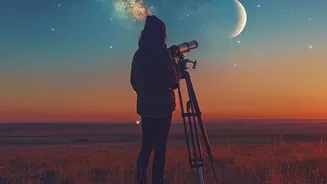
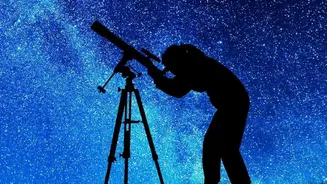
Saturn will be visible for most of the night, rising in the east around sunset and tracing a path across the sky. It shines with a steady, yellowish light, brighter than most stars. This period is the perfect run-up to its main event, offering increasingly brilliant views. You don’t need a professional telescope to spot it; its brightness makes it an easy naked-eye object. However, if you have a pair of binoculars or a small telescope, you can stabilise them to get a clearer view and perhaps even a hint of its distinct shape. Look for it in the constellation Cetus. Its majestic, all-night presence makes it a reliable and rewarding target for city dwellers and rural stargazers alike.
A Challenge: The Moon Meets Mercury
For the dedicated early risers, a delicate celestial rendezvous occurs on the morning of August 21. A slim crescent Moon will appear close to the elusive planet Mercury just before sunrise. To catch this conjunction, you will need a clear view of the eastern horizon and excellent timing. The best window for observation is a narrow one, roughly between 5:30 AM and 6:00 AM IST, as the sky begins to brighten but before the Sun’s glare washes out the view. Mercury is always a tricky planet to spot because it never strays far from the Sun. Having the Moon nearby serves as a helpful guidepost, making this a great opportunity to tick the innermost planet off your stargazing list. You will not need any special equipment, but clear, unobstructed skies are essential for this low-on-the-horizon event.
Catch the Last of the Perseid Meteors
The famous Perseid meteor shower peaked in mid-August under ideal dark-sky conditions. But the show isn't completely over. The shower remains active until the beginning of September, meaning you still have a chance to see some of its 'shooting stars'. While the rate of meteors will be much lower than the peak, patient observers can still be rewarded with the sight of a few bright Perseids streaking across the sky. The best time to look is after midnight, as the Earth turns into the stream of cometary debris. For your best chance, find a location away from city lights, let your eyes adjust to the darkness for about 20-30 minutes, and simply look up. The waxing moon around this time will set earlier in the night, leaving darker skies for late-night viewing. Patience is key, but a single, bright meteor can make the entire effort worthwhile.
Observing the First Quarter Moon
On August 20, the Moon reaches its First Quarter phase. While a Full Moon often gets all the attention, the First Quarter is arguably a more fascinating time to observe our celestial neighbour through binoculars or a small telescope. During this phase, the Moon is half-illuminated, and the dividing line between its light and dark sides is called the 'terminator'. It is along this line that the Sun is rising from the Moon’s perspective. The low-angle sunlight casts long, dramatic shadows from crater rims and lunar mountains, making these features stand out in stunning three-dimensional detail. You can easily see the rugged and pockmarked surface of the Moon. It is high in the sky during the early evening, making it a convenient and spectacular target for sky-watchers of all ages.
The Full Moon and a Distant Eclipse
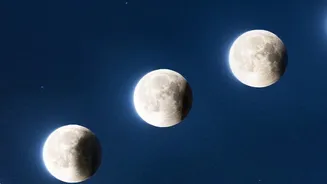
August will close with a Full Moon on August 28. This is when the Moon is fully illuminated by the Sun, rising in the east as the Sun sets in the west. It will light up the night sky, making it a poor time for spotting faint stars but a beautiful sight in its own right. On this same date, a partial lunar eclipse will occur. However, it is important for sky-watchers in India to know that this eclipse will not be visible from the subcontinent. The event will be seen across the Americas, Europe, and Africa. So, while you can enjoy the beauty of the bright Full Moon on this night, you will have to wait for a future opportunity to witness an eclipse from home.