







2001: A Space Odyssey (1968)
You can't start a list like this anywhere else. Stanley Kubrick’s masterpiece didn’t just set the bar for sci-fi visuals; it created a new cinematic language. Released before the moon landing, its depiction of space travel remains astonishingly realistic
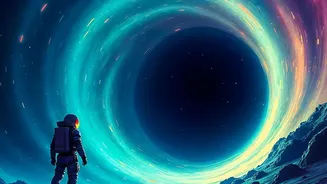
and graceful. Using meticulously detailed models, enormous rotating sets to simulate gravity, and pioneering effects, Kubrick crafted a sterile, majestic vision of the future that still feels modern. The film is a slow, deliberate ballet of spacecraft set to classical music, punctuated by the terrifyingly abstract Stargate sequence—a psychedelic journey of light and color that was revolutionary. It’s less of a movie and more of a cosmic experience, a meditation on evolution and technology that uses imagery over dialogue to pose its biggest questions.
Gravity (2013)
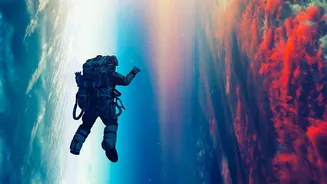
If '2001' is a stately cosmic ballet, Alfonso Cuarón’s 'Gravity' is a heart-pounding thriller that plunges you directly into the terror of being stranded in orbit. The film is a technical marvel, famous for its long, seamless takes that make you feel like you are right there with Sandra Bullock’s character, tumbling uncontrollably through the void. Cuarón’s team invented new camera systems to achieve this immersive, zero-gravity feeling. The visuals are both terrifying and beautiful, capturing the silent, deadly expanse of space while Earth hangs below like a brilliant blue marble. It’s a masterclass in using visuals to create tension and claustrophobia in the most open environment imaginable, making it a must-see in 3D or on an IMAX screen.
Interstellar (2014)
Christopher Nolan is a champion of cinematic spectacle, and 'Interstellar' is arguably his magnum opus in that regard. The film takes audiences on a journey through a wormhole, to distant planets orbiting a black hole, and even into a fifth dimension. What makes its visuals so mind-boggling is the commitment to scientific accuracy. Nolan worked with theoretical physicist Kip Thorne to ensure that the depictions of the wormhole and the black hole, Gargantua, were based on real scientific equations. The result is one of the most scientifically plausible and awe-inspiring renderings of cosmic phenomena ever put to film. From the terrifying scale of the tidal wave on the water planet to the dizzying docking sequence, every frame is designed for maximum impact on the biggest screen possible.
Ad Astra (2019)
While many space movies focus on the external wonders of the cosmos, James Gray's 'Ad Astra' uses the vastness of space to explore an internal, psychological journey. The film follows Brad Pitt’s stoic astronaut on a mission to the edge of the solar system, and the visuals are breathtakingly beautiful in their realism and melancholy. Cinematographer Hoyte van Hoytema, who also shot 'Interstellar', captures both the spectacular and the mundane aspects of future space travel. A buggy chase on the Moon is a standout sequence, presenting a familiar action trope in a completely alien, low-gravity environment. The film's aesthetic is one of lonely grandeur, using the stark, empty beauty of deep space to reflect the protagonist's own isolation.
Dune (2021)
While much of it is set on a planet's surface, Denis Villeneuve's 'Dune' is a space exploration film at its core, centered on travel between worlds and the colossal scale of a galactic empire. Villeneuve is a master of creating overwhelming scale, and every shot in 'Dune' feels immense. The ships are brutally monolithic, the alien landscapes of Arrakis are vast and inhospitable, and the sense of deep space travel feels genuinely momentous. The film's visual language, from the design of the ornithopters to the sheer size of the sandworms, transports the audience to a completely realized universe. It’s a film where the production design and cinematography do as much world-building as the script, creating a tangible sense of a sprawling, ancient future that feels both epic and grounded.