




What Exactly Is a Planetary Parade?
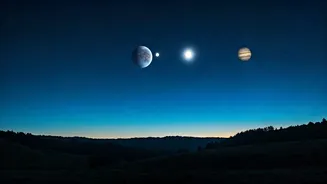
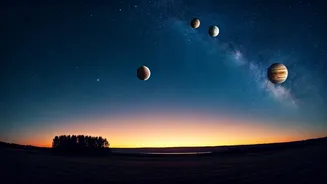
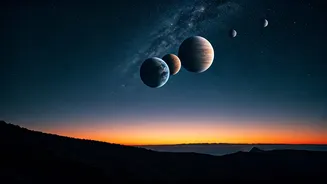
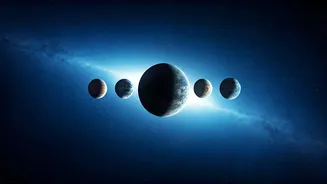
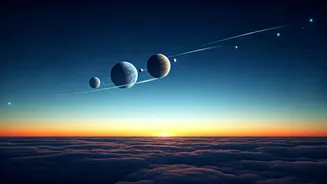
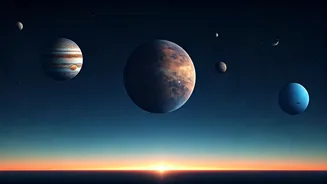
In early June, the morning sky is hosting what astronomers affectionately call a 'planetary parade'. This isn't a literal, perfectly straight line of planets, but rather an alignment where multiple planets appear in the same small sector of the sky from
our vantage point on Earth. This happens because all the planets in our solar system orbit the Sun on a relatively flat plane, known as the ecliptic. When several of them happen to be on the same side of the Sun at the same time, we get to see them clustered together. This month, six planets—Mercury, Mars, Jupiter, Saturn, Uranus, and Neptune—are making an appearance. While not an astronomically significant event in terms of scientific discovery, it's a visually stunning and rare opportunity for sky-watchers.
Which Planets Can You See?
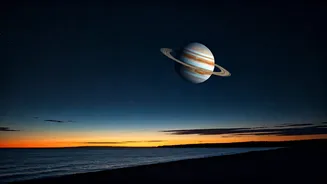
The parade features a diverse cast, but not all members are easy to spot. Your best bets for naked-eye viewing are Saturn, Mars, and a faint Mercury and Jupiter just before sunrise. Saturn will appear as a steady, yellowish point of light. Mars will be recognisable by its distinct reddish hue. Jupiter, the largest planet, will be bright but low on the horizon, making it a challenge. The real test is Mercury, which will be very close to the rising Sun and difficult to see in the glare. Uranus and Neptune are also part of the lineup but are too faint to be seen without the help of good binoculars or a small telescope. So, while six planets are technically 'up there', you should focus on spotting the bright and colourful few.
The Best Time and Place to Watch
Timing is everything for this celestial event. The ideal viewing window across India is in the pre-dawn hours, roughly 45 to 60 minutes before local sunrise. You'll need to be an early riser! The planets will be strung out across the eastern sky. To find them, face east and look for the first signs of dawn. The planets will appear as bright 'stars' that don't twinkle as much as actual stars. Saturn will rise first, followed by Mars, and then Jupiter and Mercury will appear closer to sunrise. The Moon may also be nearby, serving as a helpful guidepost depending on the specific date. The peak of this alignment occurs in the first week of June, but the planets will remain in a similar configuration for several days.
A Stargazing Guide for City Dwellers
Viewing celestial events from a light-polluted metro like Mumbai, Delhi, or Bengaluru can be frustrating, but it's not impossible. Here are some tips to improve your chances:
1. **Find an Open Horizon:** Go to a rooftop, a park, or a field with an unobstructed view of the eastern horizon. Tall buildings can block the view, especially for planets low in the sky like Jupiter and Mercury.
2. **Escape the Glare:** Try to find the darkest spot you can. Get away from streetlights, billboards, and building lights. Even moving to the side of a building that blocks a direct light source can help.
3. **Let Your Eyes Adjust:** It takes about 15-20 minutes for your eyes to become fully adapted to the dark. Put your phone away (its bright screen will ruin your night vision) and be patient.
4. **Use a Sky-Watching App:** Apps like Stellarium, SkyView, or Star Walk are incredibly helpful. They use your phone's GPS and compass to show you exactly where to look for each planet in real-time.
Patience Is Your Best Telescope
Remember, what you see won't look like a high-definition NASA photograph. The planets will appear as points of light. The 'magnificence' of the event comes from the knowledge of what you're seeing: entire worlds, hundreds of millions of kilometres away, visible with your own eyes. Mars is a desert planet, Saturn has its iconic rings (though you need a telescope to see them), and Jupiter is a gas giant so large that all other planets could fit inside it. The wonder lies in this connection to the grand scale of the cosmos. Even spotting just two or three of these distant worlds from your balcony is a profound experience, a quiet moment of cosmic perspective before the city wakes up.