








What is a Cloud Kitchen?
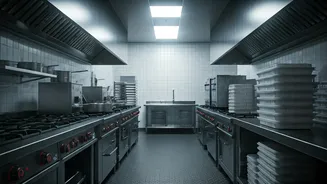
A cloud kitchen—also known as a ghost kitchen, virtual kitchen, or dark kitchen—is a commercial food production facility that operates without a physical dining space. [12] It is designed exclusively for online delivery orders. [13] Customers place orders through
food delivery platforms like Swiggy and Zomato, or a brand's own website, and the food is prepared and dispatched without any customer-facing interaction. [11] This model strips a restaurant down to its production core, eliminating the need for expensive high-street locations, seating, or front-of-house staff. [4, 6] The entire business focuses on two things: food quality and delivery efficiency. [16]
The Financial Recipe for Success
The primary advantage of a cloud kitchen is its economic efficiency. The initial investment is significantly lower than that of a traditional restaurant. [10] Entrepreneurs can avoid the heavy costs of rent in prime locations, interior design, and a large service team. [13] In many Indian cities, a cloud kitchen can be launched for a fraction of the cost of a dine-in establishment, making it an accessible entry point for new entrepreneurs. [4] This asset-light model also allows for greater operational flexibility and scalability. [16] A single, well-equipped kitchen can host multiple virtual brands, each offering a different cuisine. [8] For example, one kitchen might prepare biryani under one brand name and pizza under another, maximising the use of resources and appealing to a wider customer base. [17] This multi-brand strategy improves kitchen output and allows owners to test different food concepts with minimal risk. [2, 22]
India's Ghost Kitchen Boom
The cloud kitchen market in India has seen explosive growth, driven by increasing smartphone and internet penetration, rising urbanisation, and a fundamental shift in consumer dining habits towards convenience. [3, 7] The Indian cloud kitchen market was valued at around USD 1.24 billion in 2025 and is projected to reach USD 3.69 billion by 2034, growing at a CAGR of 12.28%. [3] Major players like Rebel Foods (the parent company of Faasos and Behrouz Biryani) and Curefoods (which operates EatFit and CakeZone) have scaled rapidly, operating hundreds of kitchens across dozens of cities. [9, 15] This growth isn't just confined to Tier-1 cities; companies are aggressively expanding into Tier-2 and Tier-3 cities where demand for online food delivery is rising fast. [17]
Not a Perfect Meal: The Challenges
Despite the attractive economics, the cloud kitchen model is not without its challenges. The low barrier to entry has created a highly saturated and competitive market. [2, 4] Standing out among hundreds of options on a delivery app is difficult. [6] Furthermore, there is a heavy dependency on food delivery aggregators like Zomato and Swiggy, which can charge high commissions of 20-30%, squeezing profit margins. [2] The lack of a physical storefront means there is no direct customer interaction or opportunity for walk-in business, making brand-building a purely digital effort focused on ratings, reviews, and online marketing. [2, 4] This makes customer loyalty harder to build compared to a traditional restaurant where the dining experience plays a key role. [10]
The Future of Food is Hybrid
Cloud kitchens have fundamentally altered the DNA of the food service industry. [26] They have proven that a successful food business can thrive without the traditional dining room, relying instead on technology, efficiency, and a deep understanding of the delivery ecosystem. [24] However, this doesn't spell the end for traditional restaurants. The experience of dining out—the ambience, the service, the social connection—is something a delivery box cannot replicate. The future is likely to be hybrid, where established restaurants use cloud kitchens as a low-cost way to expand their delivery reach, and successful cloud kitchen brands may open physical outlets to build their brand presence. [11] Cloud kitchens are no longer just an alternative; they are a permanent and powerful fixture in India's evolving food landscape. [8, 17]