
From Shadows to Certainty
A little over a decade ago, our evidence for black holes was compelling but entirely indirect. Astronomers observed stars orbiting unseen massive objects and detected powerful X-rays from matter being consumed, but the black hole itself remained invisible.
The 'event horizon'—the point of no return—was a concept confined to Albert Einstein's theories of general relativity. Proving its existence required a new way of seeing the universe. The last ten years delivered not one, but two revolutionary methods that have fundamentally changed the field, shifting it from one of inference to one of direct observation.
Hearing the Universe's Symphony
The first major breakthrough came on September 14, 2015, when the Laser Interferometer Gravitational-Wave Observatory (LIGO) detected something extraordinary: ripples in the fabric of spacetime itself. These gravitational waves were the echo of two massive black holes spiraling into each other and merging, an event that occurred over a billion light-years away. For the first time, humanity could 'hear' a cosmic event through the vibrations of spacetime, confirming a century-old prediction of Einstein's. This discovery opened an entirely new sense for perceiving the cosmos. Since that initial detection, LIGO and its international partners, Virgo and KAGRA, have documented dozens of black hole mergers, creating a catalog of cosmic collisions that was previously unimaginable.
Giving a Black Hole Its Close-Up
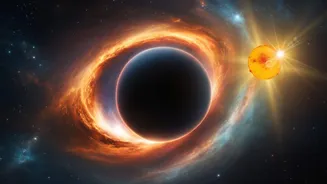
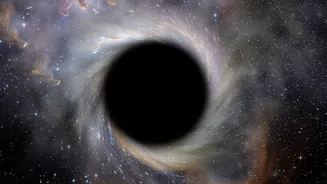
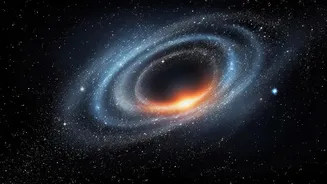
While LIGO allowed us to hear black holes, the Event Horizon Telescope (EHT) collaboration aimed to see one. This incredible project synchronized radio telescopes across the globe, from Greenland to the South Pole, creating a virtual telescope the size of Earth. Their goal was to capture an image of a black hole's 'shadow'—the dark silhouette it casts against the glowing, superheated gas swirling around it. In April 2019, they succeeded, releasing the first-ever direct image of a black hole at the center of the galaxy Messier 87. The image of a dark circle surrounded by a fiery ring of light was a stunning confirmation of theoretical predictions and instantly became a scientific icon. In 2022, the team followed up by imaging Sagittarius A*, the supermassive black hole at the center of our own Milky Way galaxy.
A New Era of Multi-Messenger Astronomy
The true power of this decade's leap lies in combining these new observational methods. Known as 'multi-messenger astronomy', scientists can now study cosmic events using both gravitational waves and electromagnetic radiation (light) simultaneously. Imagine watching a thunderstorm: you see the lightning and hear the thunder. By measuring the delay, you can tell how far away it is. Similarly, observing an event with both light-based telescopes and gravitational wave detectors provides a much richer, more complete picture of the physics involved. This integrated approach is helping scientists test the limits of general relativity and understand the extreme environments around black holes with unprecedented detail.