

Why Your Hips Protest After Sitting
The human body is designed for movement. When you spend hours in a chair, your hips are held in a flexed position. This causes the muscles at the front of your hips, the hip flexors, to become short and tight. At the same time, the muscles in your buttocks,
the glutes, become inactive and weak from lack of use. This common muscular imbalance is a primary driver of that stiff, locked-up feeling. It can pull your pelvis out of alignment, contribute to lower back pain, and make simple movements like standing up or walking feel like a chore. Taking frequent breaks to stand and move every 30 to 60 minutes can significantly help, but targeted exercises are key to restoring balance.
The Kneeling Hip Flexor Lunge
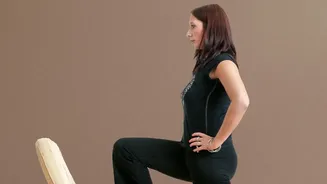
This is a foundational stretch for anyone who sits a lot, as it directly targets those tight hip flexors. To perform it, start by kneeling on one knee, perhaps on a cushion or mat for comfort. Place your other foot flat on the floor in front of you, creating a 90-degree angle with your knee. Keeping your back straight, gently shift your hips forward until you feel a comfortable stretch in the front of the hip of your kneeling leg. It’s important to keep your core engaged to avoid arching your lower back. Hold this position for 20 to 30 seconds, breathing deeply, before switching to the other side. This stretch helps lengthen the muscles that have been shortened from hours of sitting.
The Glute Bridge
While you stretch the front, it's crucial to strengthen the back. The glute bridge reactivates the gluteal muscles that often 'switch off' during long periods of sitting. Lie on your back with your knees bent, feet flat on the floor about hip-width apart, and your arms by your sides. Squeeze your glutes and lift your hips off the floor until your body forms a straight line from your shoulders to your knees. Hold for a few seconds at the top, focusing on the contraction in your glutes, then slowly lower back down. Aim for 10 to 15 repetitions. This exercise not only strengthens your glutes but also improves pelvic stability.
The 90/90 Stretch for Hip Rotation
Modern life doesn't just limit our forward-and-back hip movement; it also restricts rotation. The 90/90 stretch is excellent for improving both internal and external rotation of the hip. Sit on the floor and position your legs so that your front shin is parallel to the front of your mat, and your back shin is parallel to the side, with both knees bent at a 90-degree angle. Try to keep both sit bones on the floor as you sit up tall. You can lean forward over your front leg to deepen the stretch. Hold for about 30 seconds before carefully switching sides. This movement helps to release tension deep within the hip capsule.
Cat-Cow for Spinal and Pelvic Mobility
Hip health is closely linked to spinal health. The cat-cow stretch, a staple in yoga, encourages gentle movement through the spine and pelvis, which can help relieve tension built up from a static sitting posture. Start on your hands and knees in a tabletop position, with your wrists under your shoulders and your knees under your hips. As you inhale, drop your belly, lift your chest and tailbone, and look forward (Cow). As you exhale, round your spine toward the ceiling, tucking your chin and tailbone (Cat). Flow between these two positions for 8 to 10 repetitions, linking your breath to the movement.