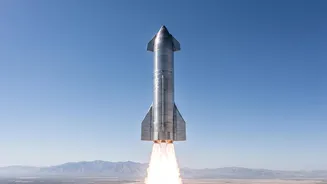





The world’s most powerful rocket, SpaceX's Starship, is set to undertake its next ambitious test flight, with a planned trajectory that will see it soar over the Indian subcontinent multiple times. Here’s what you need to know.
The World's Most Powerful Rocket
Starship is SpaceX's next-generation,
fully reusable launch system, designed with the audacious goal of making humanity a multi-planetary species. Standing taller than any rocket ever built, its two stages—the Super Heavy booster and the Starship spacecraft—are engineered not just to reach orbit, but to do so repeatedly. The system is central to NASA's plans to return astronauts to the Moon and to Elon Musk's long-term vision of establishing a self-sustaining city on Mars. Each test flight is a critical step in proving the vehicle's capability and reliability. Previous flights have tested various components, from launch and stage separation to atmospheric reentry, with some missions even deploying satellites into orbit. The upcoming test, Starship Flight 15, is slated to be the most ambitious yet, building on lessons from its predecessors.
A Journey Across the Planet
The upcoming Starship Flight 15 is scheduled for launch from SpaceX's Starbase in Texas, with a window opening early on November 14 in Indian Standard Time. According to the mission profile, the spacecraft is planned to enter orbit and circle the Earth approximately 14 times over a mission lasting more than 22 hours. This extended flight plan means the spacecraft will repeatedly pass over various parts of the globe, including several passes over India. The trajectory is not specifically designed to fly over India but is a consequence of the physics of its orbital path, determined by its launch location, target altitude of about 275 km, and inclination. The mission's primary goals are to test the spacecraft's long-duration flight capabilities and, for the first time, attempt to catch both the returning Super Heavy booster and the Starship upper stage back at the launch site.
Will You Be Able to See It?
The prospect of seeing a 120-metre rocket in the sky is tantalizing, but reality requires managing expectations. Starship will be flying at an orbital altitude of hundreds of kilometers while traveling at speeds of over 27,000 km/h. From the ground, it will not appear as a large, slow-moving object like the International Space Station (ISS). Visibility will be highly dependent on timing and conditions. The best chance to spot it would be during passes at dusk or dawn, when the sky is dark but the spacecraft is still high enough to be illuminated by the sun. Even then, it would likely appear as a faint, fast-moving point of light, possibly visible for only a very brief period. Specialized equipment or dedicated tracking apps, which provide real-time location data, would offer the best chance for a confirmed sighting.
Safety and Reentry
Whenever a massive object flies overhead, safety is a natural concern. SpaceX and the US Federal Aviation Administration (FAA) have designed the flight path with safety as a paramount concern. The initial launch places Starship on a 'passively safe' suborbital trajectory. This means that if any problems occur during ascent, the spacecraft would naturally reenter and splash down in a pre-cleared, unpopulated area of the Indian Ocean, a procedure used in previous test flights. Only after flight controllers confirm all systems are healthy does the rocket perform a final burn to enter a stable orbit. The risk to people on the ground is infinitesimally small, as the spacecraft remains at an extremely high altitude during its passes over land. Any planned deorbit or emergency splashdown zones are located far from populated areas over the ocean.