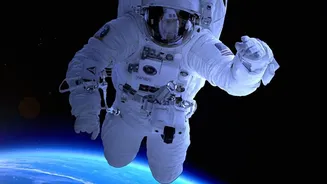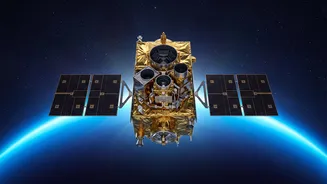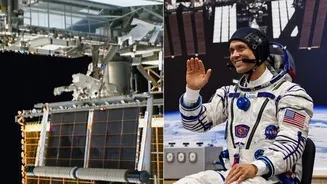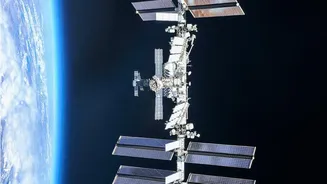

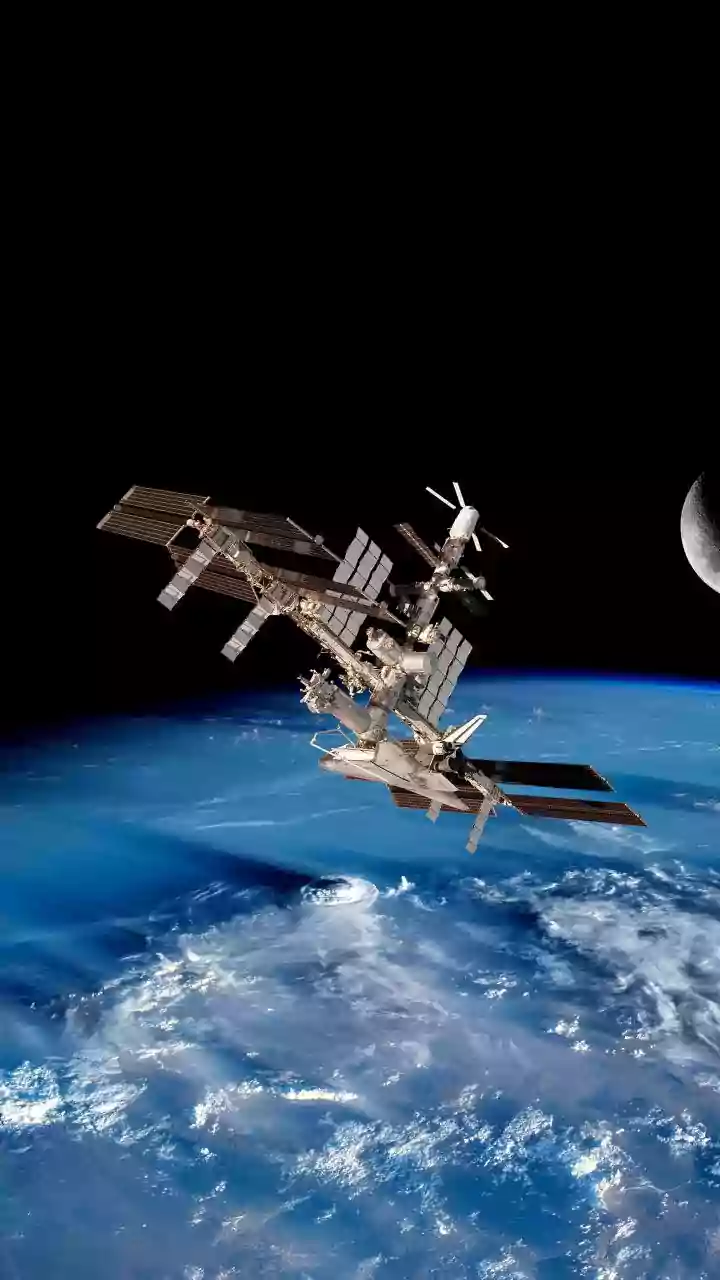

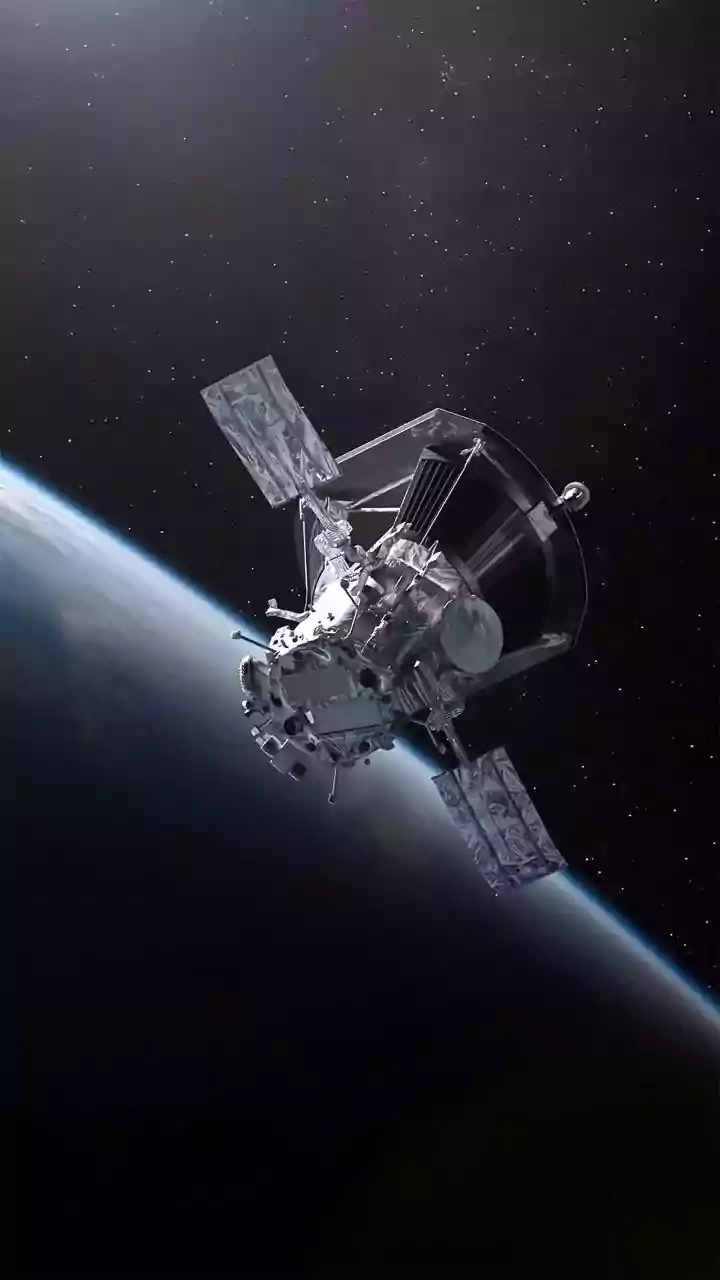



The International Space Station glides across the sky, a beacon of human ingenuity. But it isn't 'flying' like a plane. In reality, the ISS is in a constant, controlled fall around our planet, a delicate dance between gravity and immense speed.
A Perpetual Fall
To understand
how the ISS stays up, you first have to accept a strange truth: it doesn't. It's constantly falling towards Earth. The trick is that it's also moving sideways at an incredible speed. Imagine throwing a baseball. It moves forward and also falls downwards, eventually hitting the ground. Now, imagine you could throw that ball so fast that as it falls, the Earth's surface curves away from it at the exact same rate. The ball would just keep falling 'around' the Earth, never getting any closer. That's an orbit. It’s less about defying gravity and more about harnessing it. Sir Isaac Newton first imagined this with a thought experiment involving a cannon on a mountaintop. Fire a cannonball slowly, and it lands nearby. Fire it faster, and it lands farther away. But fire it at a precise, blisteringly fast speed, and it will circle the entire planet, continuously falling but never landing. This 'falling and missing' is the essence of orbital mechanics.
The Magic Number: 17,500 MPH
For the International Space Station, orbiting at an altitude of roughly 250 miles, the magic number is about 17,500 miles per hour (or 5 miles per second). At this velocity, the station's forward momentum is perfectly balanced with the pull of Earth's gravity. The result is a stable, circular path where the station and everything inside it are in a continuous state of freefall. This is what creates the sensation of weightlessness, or microgravity. The astronauts, the equipment, and the station itself are all falling together at the same rate, so they appear to float relative to one another. Maintaining this velocity is the single most critical task in operating the station. It's not a 'set it and forget it' situation. The physics might be constant, but the environment of space is not perfectly empty, which introduces a crucial problem.
Death by a Thousand Whispers: Atmospheric Drag
Although the ISS is 250 miles up, it's not in a perfect vacuum. It orbits in the thermosphere, an extremely thin outer layer of Earth's atmosphere. While the air molecules are few and far between, there are still enough of them to create a tiny but constant amount of friction, or drag, on the station. Think of it like the air resistance you feel when you stick your hand out of a moving car's window, but on a much, much smaller scale. Over time, this persistent, whisper-light drag acts as a brake. It slowly bleeds off the station's incredible velocity. As the ISS slows down, gravity starts to win the tug-of-war. The station's orbit begins to decay, causing it to lose altitude by as much as 100 meters per day. Left unchecked, this orbital decay would eventually cause the multi-billion dollar laboratory to spiral back into the thicker parts of the atmosphere and burn up.
Giving It a Nudge: The Art of the Reboost
This is where the business of managing the station's orbit comes in. To counteract the inevitable decay caused by atmospheric drag, the ISS must be periodically pushed back up to its proper altitude and speed. This maneuver is called an orbital 'reboost'. It’s the space equivalent of giving a kid on a swing a push to keep them going. These reboosts are a core part of the station's operational logistics and are carefully planned by flight controllers on the ground. They are typically performed in one of two ways. Sometimes, the station uses its own thrusters, located on the Russian Zvezda Service Module. More often, the thrusters of a docked visiting vehicle—like Russia's Progress cargo ship or Northrop Grumman's Cygnus spacecraft—are fired for a specific duration. This provides the gentle, sustained push needed to raise the station's orbit and restore the velocity lost to drag, ensuring the delicate balance is maintained.