





The Great Melt Down South
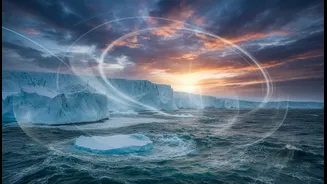
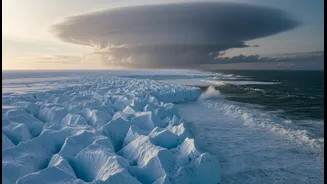
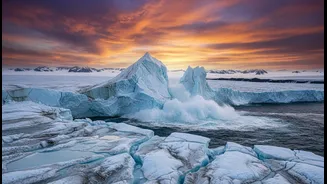
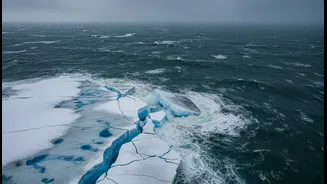
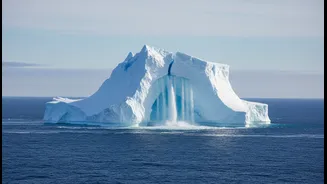
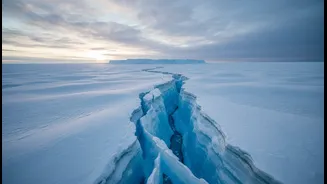
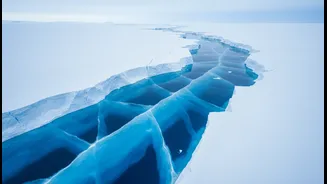
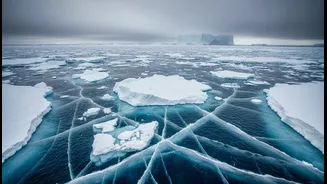
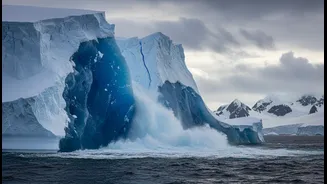
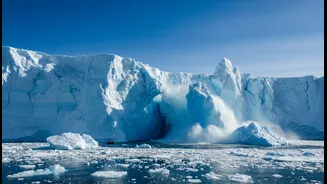
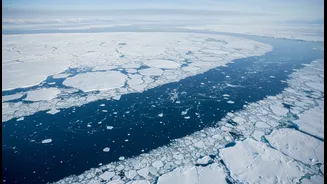
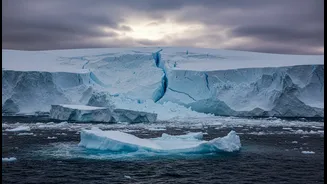
Antarctica is losing its ice at an alarming pace. This isn't just about icebergs breaking off; the real danger is more insidious. Warming ocean currents are seeping beneath the massive floating ice shelves that fringe the continent, melting them from
below. These shelves act like a cork in a bottle, holding back the colossal glaciers on the landmass. As they thin and weaken, the land-based ice behind them accelerates its slide into the sea. Scientists have observed that this process, which is causing rapid ice loss in places like Greenland, is now taking hold in Antarctica. Even parts of East Antarctica, once thought to be stable, are showing signs of vulnerability, prompting fears that current climate models may underestimate the speed of this change.
From Pole to Port: The India Connection
This melting ice doesn't stay in the Southern Ocean. Its single biggest consequence is global sea-level rise, and India's 7,500-kilometre coastline is squarely in the path of this threat. Over 250 million people live in India's coastal districts, with megacities like Mumbai, Kolkata, Chennai, and Kochi particularly exposed. Studies project that by 2050, large parts of these cities could face recurring and severe flooding. Projections indicate a potential sea-level rise of 20-30 cm by 2050 under medium-emission scenarios, placing millions of homes, critical infrastructure, and the economic hearts of our biggest cities at grave risk. While a complete melt would take centuries, the current trajectory alone threatens to displace millions and cause hundreds of billions of dollars in damage.
The Unseen Hand on the Monsoon
The impact goes beyond flooded coastlines. Recent scientific discoveries have revealed a deep, historical link between Antarctica's ice and the Indian monsoon. By studying ancient fossils in Nagaland, scientists found that the initial formation of the Antarctic ice sheets 34 million years ago shifted global weather patterns, which helped establish the monsoon system that India depends on. The reverse is now a serious concern: the rapid melting of that same ice could disrupt the delicate balance that drives the monsoon. For a nation where agriculture is the backbone of the economy and the livelihood for a majority, any change to the timing and intensity of the monsoon could be catastrophic, affecting everything from food security to water availability for over a billion people.
India's Polar Presence
This is not a distant problem that India is merely watching. For over four decades, our country has been an active participant in Antarctic research. Through the Indian Antarctic Programme, managed by the National Centre for Polar and Ocean Research (NCPOR), India operates two permanent research stations, Maitri and Bharati. Indian scientists are on the front lines, studying glaciology, atmospheric sciences, and biology to understand the changes taking place. This strategic presence ensures that India is not just a victim of polar melting but an active contributor to the global science seeking to understand and mitigate it. The planned construction of a new station, Maitri-2, further cements India's long-term commitment to polar research.
A Challenge for India's Next Generation
Understanding and responding to the Antarctic crisis is one of the defining challenges of our time, and it presents a unique opportunity for young Indians. This is not just a problem for glaciologists. We need engineers to design resilient coastal infrastructure, policymakers to create effective adaptation strategies, computer scientists to build better climate models, and diplomats to navigate the complex geopolitics of a changing world. Careers in oceanography, atmospheric science, environmental law, and sustainable development will be crucial. India's growing role on the world stage, combined with its scientific legacy in Antarctica, creates a platform for a new generation to lead, innovate, and build a more secure future in the face of this global threat.