



Capturing the Flash
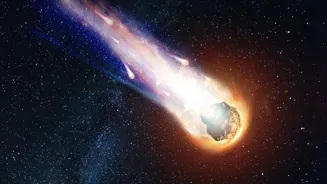
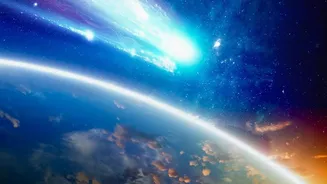
The first step in tracking a meteor is to see it, but a single sighting isn't enough. Scientists rely on networks of automated cameras and radar systems that constantly watch the sky. When a meteoroid enters the atmosphere and becomes a meteor, multiple
stations can record its fiery journey. By combining these different viewpoints, researchers can use triangulation to reconstruct the meteor's precise path through the atmosphere, including its speed and angle of entry. This is crucial for the next step: calculating its life before it met Earth.
Rewinding the Cosmic Clock
Once the atmospheric trajectory is known, scientists can work backwards. Using complex models that account for Earth's gravity and its motion through space, they calculate the meteoroid's original orbit around the Sun. This orbital path is a major clue to its origin. For example, many meteor showers occur when Earth passes through the dusty debris trail left by a specific comet. If a meteor's orbit matches that of a known comet, like Swift-Tuttle for the Perseids, its origin story becomes much clearer. Others can be traced back to the asteroid belt between Mars and Jupiter.
A Fingerprint of Light
Even as a meteor burns up, it reveals its secrets. The intense heat causes the meteoroid's material to vaporise, and the elements within it emit light at specific, characteristic wavelengths. This is where spectroscopy comes in. By splitting the meteor's light into a spectrum, like a rainbow, scientists can read its chemical fingerprint. The presence and intensity of lines for elements like iron, magnesium, and sodium help classify the meteoroid. This tells them if it was a rocky, metallic, or a mixed-composition object, narrowing down the type of parent body it came from.
When a Piece Survives
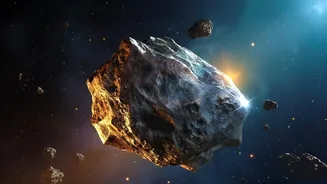
Most meteors disintegrate completely, but if a piece is large enough to survive the fiery descent and land on Earth, it becomes a meteorite—a priceless scientific treasure. These physical samples allow for far more detailed analysis. Scientists can slice them open to study their internal structure, identifying features like chondrules—tiny, ancient spherical grains that formed in the early solar system. These are not found in Earth rocks and are a tell-tale sign of a primitive meteorite. The presence of a dark, glassy 'fusion crust' from its atmospheric entry also helps confirm its extraterrestrial origin.
Cosmic DNA Testing
In the lab, meteorites undergo what amounts to a cosmic DNA test. Using a technique called mass spectrometry, scientists can measure the ratios of different isotopes—versions of an element with slightly different masses. These isotopic ratios are unique signatures that vary for different bodies in the solar system. For instance, the mix of oxygen isotopes in meteorites from Mars is distinct from that of Earth rocks or meteorites from the asteroid Vesta. Sometimes, tiny pockets of gas trapped within the meteorite can be analysed and matched to the atmosphere of another world, like Mars, providing a direct link.
Building a Family Tree
By combining all this evidence—orbital path, chemical composition from spectroscopy, and detailed isotopic analysis of any landed meteorites—scientists can start to build a family tree. They compare a meteorite's spectral and compositional data to observations of known asteroids. For example, the HED group of meteorites has been convincingly linked to the giant asteroid 4 Vesta. While not every space rock can be traced to a specific named object, they can often be sorted into one of about 150 distinct parent bodies, each representing a shattered asteroid or ancient planetesimal with a unique history.