



What Exactly is a Quasar?
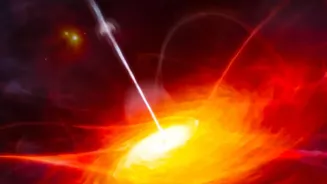
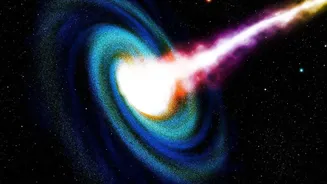
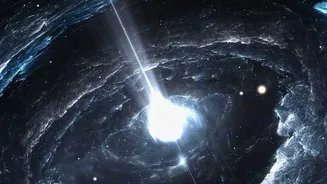
Before diving into the discovery, let's clarify what a quasar is. Short for 'quasi-stellar object', a quasar is the intensely luminous core of a distant galaxy. This light isn't from stars, but from a supermassive black hole at the galaxy's center that
is actively consuming enormous amounts of gas and dust. As this material spirals into the black hole, it forms a superheated accretion disk that can outshine all the stars in its host galaxy combined. Because they are so bright, quasars act as cosmic lighthouses, allowing astronomers to study the conditions of the very early universe.
A Discovery at the Dawn of Time
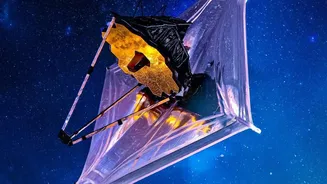
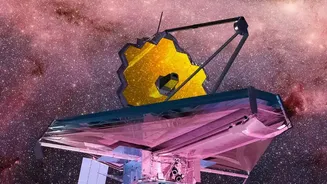
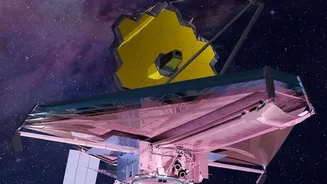
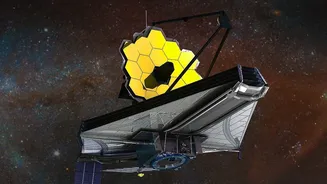
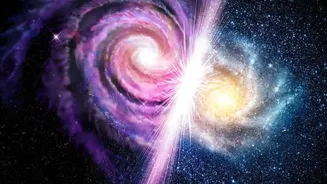
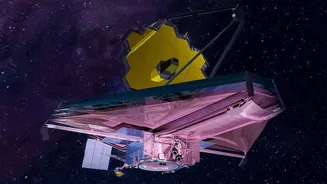
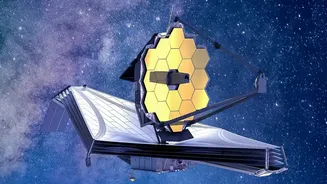
An international team of astronomers using the JWST discovered what appeared to be two quasars, designated J1602+4228AB, existing just 900 million years after the Big Bang. This places them in an era known as 'cosmic dawn', when the first stars and galaxies were forming. The find was part of the Aether survey, a JWST program aimed at creating a census of objects in the early universe. During a visual inspection of the data, scientists noticed that one known quasar had a faint companion. This was a surprise, as finding even one supermassive black hole this massive, this early in cosmic history, pushes the limits of current theories. Finding a pair was unprecedented.
Why a Second Look Was Crucial
JWST's powerful infrared vision was excellent at spotting the two faint dots of light so close together. However, a possibility remained that it wasn't a true pair of quasars. It could have been a single quasar whose light was being bent and duplicated by the gravity of a closer, unseen galaxy—a phenomenon known as gravitational lensing. To confirm they were two distinct objects and to understand their physical properties, scientists needed a different kind of observation. They needed detailed spectra—a breakdown of the light from each object—to prove they were separate entities with unique characteristics. This is where the vital collaboration with a ground-based telescope came into play.
Gemini North Confirms the Pair
To get that crucial follow-up data, the team turned to the Gemini North telescope in Hawai'i, one half of the International Gemini Observatory. Despite the objects being incredibly close and faint, near-perfect weather conditions over Mauna Kea allowed Gemini's Near-Infrared Spectrograph (GNIRS) to successfully resolve the two quasars individually. The spectra it collected confirmed they were indeed two separate quasars, not a gravitational lens illusion. Gemini's data was so detailed it allowed scientists to measure key properties, confirming the black holes have masses about 1.5 billion and 400 million times that of our sun, respectively. The Hawaiian language college Ka Haka ʻUla O Keʻelikōlani gave the pair the name Nāpōwawāʻenakaulua, meaning 'two celestial bodies of fathomless powerful darkness in the brilliance of heat'.
Rewriting Cosmic History
The existence of Nāpōwawāʻenakaulua challenges our understanding of how cosmic structures form. According to current models, black holes shouldn't have had enough time to grow this massive so early in the universe's 13.8-billion-year history. The fact that two are found together in a merging galaxy system suggests that galaxy collisions were a key driver of rapid black hole growth in the early universe. Researchers propose that this pair might signify an unusually dense region of the early cosmos, where galactic interactions fueled both star formation and black hole growth simultaneously. This discovery provides a unique natural laboratory for studying how the very first massive galaxies and their central black holes came together.