




More Than Just a Simple Pull
We all learn that gravity is the force that keeps our feet on the ground and planets in orbit. It’s a pull that one object exerts on another. But the strength of that pull depends on distance. The closer you are, the stronger the pull. This simple fact
is the key to understanding how a planet can destroy its own moon. A large planet doesn't pull on a nearby moon with one uniform force. Instead, it pulls more strongly on the side of the moon facing it and more weakly on the side facing away. This difference in gravitational force across an object is what astronomers call a tidal force.
The Cosmic Stretch Effect
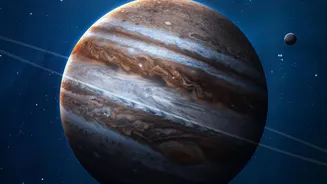
Think of this differential gravity as a cosmic stretching machine. The part of the moon nearest the planet is pulled aggressively, while the far side is left lagging behind. This creates a stress that stretches the moon along the line connecting it to the planet. For moons orbiting at a safe distance, this stretching is minor, causing only small 'body tides' where the solid surface of the moon might bulge slightly. Jupiter's moon Io, for example, is constantly squeezed and stretched by the planet's immense gravity, which generates enormous internal heat and fuels its famous volcanoes.
The Point of No Return
So, when does this stretching become deadly? There is a critical boundary around every large celestial body known as the Roche limit, named after the French astronomer Édouard Roche who first calculated it in the 19th century. The Roche limit is the minimum distance at which a smaller body, held together only by its own gravity, can survive. If a moon or comet strays inside this limit, the tidal forces exerted by the larger planet will overwhelm the moon's own gravitational glue. The stretching force becomes so intense that it pulls the moon apart.
A Celestial Crime Scene
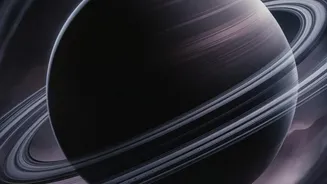
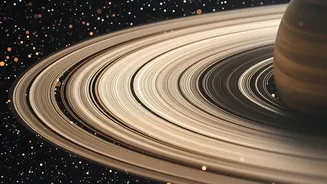
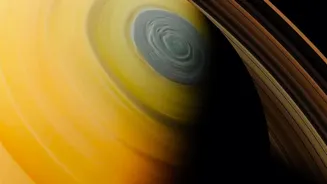
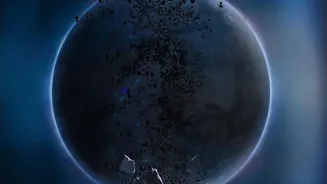
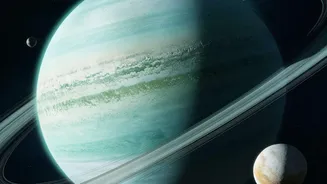
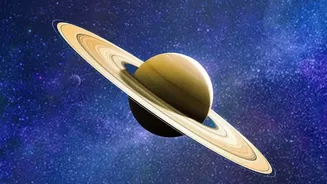
When a moon crosses the Roche limit, it disintegrates. The resulting debris doesn't just vanish; it typically spreads out into a flat disc of material orbiting the planet. This is how many scientists believe planetary rings are formed. The glorious rings of Saturn, for example, lie within Saturn's Roche limit. This suggests they are the remnants of a former moon (or moons) that drifted too close and was torn to shreds. A recent theory even names this hypothetical lost moon 'Chrysalis', which was shattered around 160 million years ago, with its icy fragments forming the rings we see today.
Witnessing a Cosmic Collision
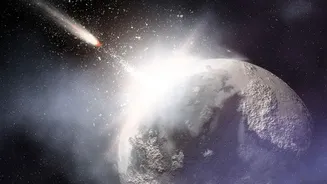
We don't just have to look at ancient rings for evidence. Humanity witnessed this process unfold in 1994 with Comet Shoemaker-Levy 9. Two years prior, the comet had passed within Jupiter's Roche limit and was broken into at least 21 fragments. Astronomers watched as this 'string of pearls' continued its orbit, before spectacularly crashing into Jupiter's atmosphere over six days. The largest fragment released energy equivalent to 6 million megatons of TNT, leaving a dark impact scar larger than the Earth itself. It was the first time a collision between two solar system bodies was directly observed, providing a dramatic, real-time confirmation of how destructive tidal forces can be.