

The Sun’s Unseen Threat
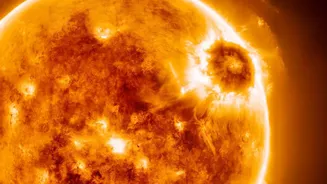
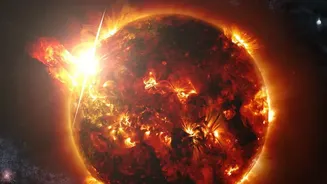
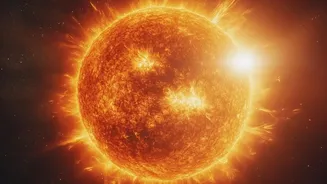
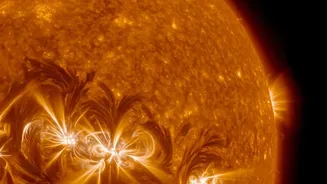
While the headline mentions solar flares, the greater danger to our power grid often comes from a related phenomenon: Coronal Mass Ejections (CMEs). A solar flare is an intense burst of radiation that reaches Earth in about eight minutes, primarily disrupting
radio and GPS signals. Think of it as the muzzle flash. A CME, on the other hand, is the cannonball—a colossal cloud of magnetized plasma and solar particles that erupts from the sun’s corona. These ejections travel much more slowly, taking anywhere from 15 hours to several days to cross the 93 million miles to Earth. If a CME is aimed at our planet, its collision with Earth’s magnetic field can trigger a powerful geomagnetic storm. This is what creates beautiful auroras, but it can also induce powerful, uncontrolled electrical currents (Geomagnetically Induced Currents or GICs) in long conductors on the ground, like power lines and pipelines. These rogue currents can overload and damage high-voltage transformers, critical components of the grid that are difficult and time-consuming to replace, potentially leading to widespread and long-lasting blackouts.
Blocking the Sun to See It Better
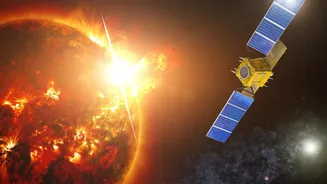
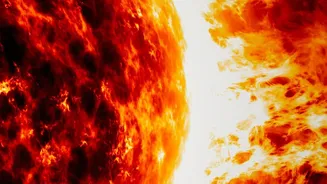
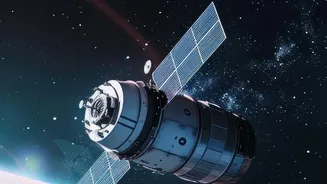
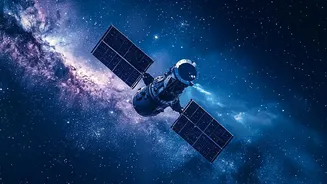
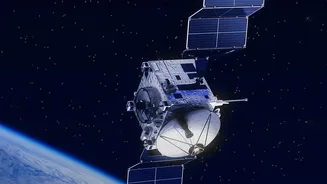
To see a CME coming, scientists need a special kind of telescope called a coronagraph. The sun's surface, or photosphere, is so blindingly bright that it completely obscures its much fainter outer atmosphere, the corona. A coronagraph works by creating a tiny, artificial eclipse. An occulting disk inside the instrument blocks the direct light from the sun, allowing the faint light of the corona to be seen and imaged. This is the only way to get a clear view of CMEs as they erupt and billow away from the sun. While ground-based coronagraphs exist, they are hampered by light scattering in our atmosphere. For the best and clearest view, these instruments are placed on satellites far from Earth, where they can monitor the sun continuously. Space-based coronagraphs on satellites like the Solar and Heliospheric Observatory (SOHO) and NOAA's GOES series provide the essential imagery used for space weather forecasting.
From Deep Space to an Operator's Desk
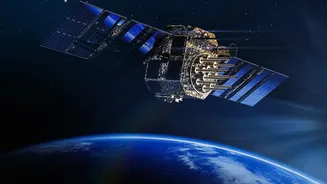
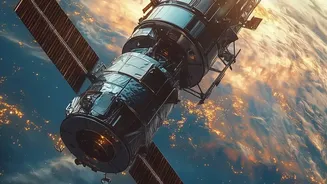
The warning process is a race against a cosmic clock. When a coronagraph on a satellite like SOHO detects an Earth-directed CME, the data is sent to forecasting centers like NOAA’s Space Weather Prediction Center (SWPC). Analysts model the CME’s speed and trajectory to predict its arrival time and potential intensity. This allows the SWPC to issue watches and warnings hours or even days in advance. As the CME cloud travels, another satellite plays a key role. The Deep Space Climate Observatory (DSCOVR), positioned about a million miles from Earth at the L1 Lagrange point, acts as a final tripwire. When the CME's shockwave passes DSCOVR, its instruments measure the speed, density, and magnetic field orientation of the incoming plasma. This data gives forecasters a final, high-confidence warning of 15 to 60 minutes before the storm hits Earth’s magnetic field, confirming the expected severity. This information is immediately relayed to power grid operators and other critical infrastructure partners.
Bracing for Impact on the Grid
With a warning in hand, grid operators can take protective actions to mitigate the storm's impact. They don't have to simply wait for the lights to go out. Based on the severity of the forecast, operators can re-route power, reduce the load on vulnerable parts of the system, and postpone non-essential maintenance. One key strategy is to increase reactive power reserves, which helps stabilize grid voltage when GICs begin to flow. In cases of a severe G4 or G5 storm warning, operators might preemptively take certain high-voltage transmission lines out of service to protect the transformers connected to them. While this sounds drastic, it's a controlled measure to prevent catastrophic and expensive physical damage. The advance notice from coronagraphs and other space weather satellites is what makes these defensive maneuvers possible, transforming a potential disaster into a manageable operational challenge.