






More Than Just an Empty Desk
First, let's redefine minimalism for the workspace. It’s not about having a barren, empty desk where nothing is allowed. Instead, it is the practice of intentionality. A minimalist setup is one where every single item has a clear purpose and a designated
place. This philosophy is designed to reduce visual clutter, which studies have shown can directly impact mental clarity. When your surroundings are chaotic, your brain has to work harder to filter out distractions, leading to mental fatigue and reduced focus. A clean, organized environment, on the other hand, promotes a sense of control and calm, freeing up your cognitive resources to concentrate on the tasks that matter. The goal is to create a space that feels expansive, focused, and free of unnecessary noise—both visual and mental.
Let There Be (Smart) Light
Lighting is one of the most powerful and underrated tools in design. It does more than just illuminate a room; it sculpts the atmosphere and directly influences our mood and energy levels. Smart lighting takes this principle to a new level. It's not just about a single bulb, but an entire ecosystem that adapts to your needs. For high-focus work, cool, bright light that mimics natural daylight can boost alertness and concentration. Research shows this type of light can increase the brain's production of serotonin and dopamine, which improve mood and motivation. Conversely, as the day winds down, you can transition to warmer, softer tones to signal to your body that it's time to relax. Smart systems allow you to automate this cycle, personalizing your environment for peak productivity and well-being without touching a switch.
The Unseen Enemy: Cable Clutter
Nothing shatters a minimalist aesthetic faster than a tangled nest of wires. The modern workspace, with its laptops, monitors, chargers, and peripherals, is a breeding ground for cable chaos. This 'digital octopus' creates visual stress and makes a space feel messy and disorganized, no matter how tidy the desk surface is. The very sight of jumbled cords can subconsciously contribute to feelings of being overwhelmed. Hidden cable management is therefore not just an aesthetic choice; it's a functional necessity for a minimalist setup. By concealing wires, you remove a major source of visual distraction, reinforcing the sense of order and control that is central to minimalist philosophy. A clutter-free desk allows the mind to be clutter-free.
Your Guide to Hidden Wires
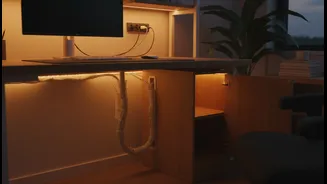
Taming your cables is easier than you think, and the solutions can be incredibly simple and effective. Start by choosing wireless devices wherever possible, like a wireless mouse, keyboard, and chargers. For the remaining essential cables, group them together using reusable velcro ties or fabric cable sleeves. These bundle wires into a single, neat channel. You can then guide this channel along the back edge or underside of your desk using adhesive cable clips. For a truly invisible solution, consider an under-desk cable management tray or basket. These mount directly to the bottom of your desk, providing a hidden shelf to hold a power strip and all your excess cable length, keeping everything completely off the floor and out of sight.
Creating a Seamless Sanctuary
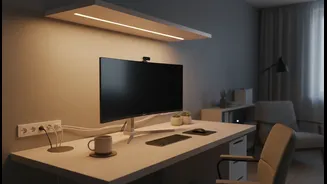
The magic happens when smart lighting and hidden cable management work in synergy. Imagine a workspace where the light automatically adjusts to the perfect color temperature for focus, with no harsh glares or shadows. Now, picture that clean light illuminating a smooth, uncluttered surface, with no distracting black wires snaking across the desk or dangling to the floor. This combination creates a seamless, unified environment. The technology is present and functional, but it’s integrated so perfectly that it becomes almost invisible. Smart lighting enhances the clean lines of the space, while hidden cables ensure those lines remain unbroken. This is the essence of modern minimalism: leveraging technology not to add complexity, but to artfully remove it.