

Why Our Planetary Neighbour Is Such a Mystery
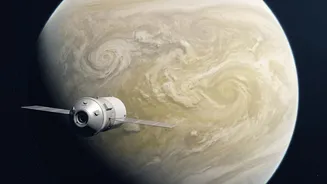
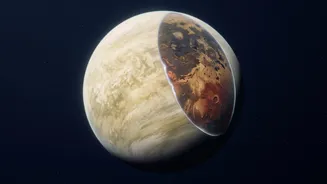
Venus is both our closest planetary neighbour and one of the solar system's most enigmatic worlds. Despite being similar to Earth in size and mass, it evolved into a hellish landscape. The planet suffers from a runaway greenhouse effect, with a crushing
atmosphere over 90 times denser than Earth's and surface temperatures hot enough to melt lead, soaring above 460°C. Its entire surface is perpetually hidden by a thick, unbroken blanket of sulfuric acid clouds, making direct observation with conventional telescopes impossible. Scientists are deeply curious about why these two sibling planets had such drastically different fates. Understanding Venus’s climate could offer crucial insights into planetary evolution and serve as a sobering cautionary tale for Earth.
The Solution: Seeing with Radar
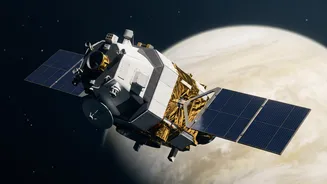
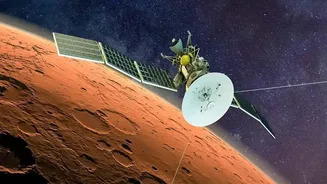
To get past the planet’s impenetrable cloud cover, ISRO’s Shukrayaan-1 orbiter will not rely on visible light. Instead, its primary tool will be a high-resolution Synthetic Aperture Radar (SAR). Think of it like a bat’s echolocation, but far more advanced. The SAR sends powerful radio waves towards the planet's surface. These waves travel unimpeded through the thick clouds, bounce off the geological features below, and return to the orbiter. By analysing these returning signals, scientists can construct a detailed, high-resolution 3D map of the Venusian terrain—day or night, rain or shine. This technology is the key to finally pulling back the curtain on a world we know so little about.
Going Deeper Than Ever Before
Shukrayaan-1 isn’t just planning to map the surface; it’s designed to be the first mission ever to systematically study what lies beneath it. The orbiter will carry a groundbreaking Ground-Penetrating Radar, an instrument never before used at Venus. This radar will send lower-frequency waves that can penetrate the top layers of the planet's crust, allowing scientists to investigate its shallow subsurface geology, rock layers, and potentially find buried structures like ancient lava flows. This could provide the first-ever look at the stratigraphy of Venus, offering clues about its volcanic history and geological evolution.
A Comprehensive Atmospheric Study
While peering through the clouds is a primary goal, the mission will also carry a suite of instruments to study the hostile atmosphere itself. Payloads developed by ISRO and international partners from Sweden, France, and Russia will analyse the atmospheric composition from top to bottom. These sensors will investigate the chemical makeup of the clouds, monitor for lightning, track the super-rotating winds, and study how the solar wind interacts with the upper atmosphere. Some instruments, like the Venus Infrared Atmospheric Gases Linker (VIRAL), will even search for trace gases like phosphine, which, while highly debated, has been considered a potential biosignature.
The Mission Plan for India’s First Venus Voyage
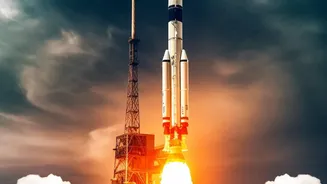
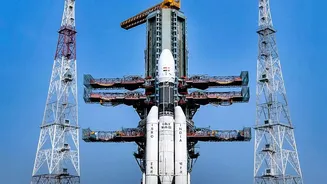
Officially approved by the Indian government in 2024, the Shukrayaan mission is scheduled to launch aboard the powerful LVM-3 rocket on March 29, 2028. After a journey of about 112 days, it will enter a large elliptical orbit around Venus. From there, ISRO will perform a delicate, months-long manoeuvre called aerobraking—using the friction of the planet’s upper atmosphere to gradually lower and circularise the orbit. This fuel-efficient technique, a first for an Indian interplanetary mission, will place the spacecraft in the ideal orbit of around 200 by 600 kilometres for its four-year scientific investigation.