


Ice Volcanoes at the Solar System's Edge
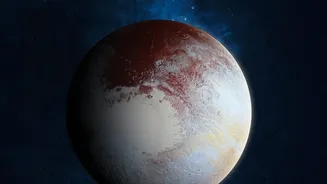
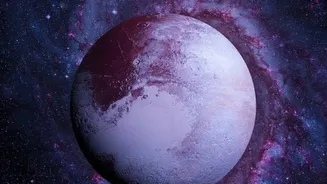
One of the most stunning discoveries on Pluto is evidence of cryovolcanism, or ice volcanoes. Unlike volcanoes on Earth that spew molten rock, cryovolcanoes erupt a slushy mix of water ice, nitrogen, and ammonia. Scientists have identified two large mountains,
Wright Mons and Piccard Mons, that appear to be massive cryovolcanoes. Wright Mons is about 4-5 kilometres high and 150 kilometres wide. These are not single peaks but are likely formed by multiple, overlapping eruptions of icy material, creating a unique, lumpy terrain found nowhere else. The near-total lack of impact craters on these features suggests they are geologically young, meaning they formed relatively recently in the solar system's history. This discovery was shocking because a small, distant body like Pluto was expected to have lost all its internal heat billions of years ago.
The Puzzle of a Hidden Heat Source
The existence of cryovolcanoes poses a fundamental question: where is the heat coming from? Pluto is too small and too far from the Sun to have significant heat from solar radiation, and it doesn't experience the strong gravitational tug-of-war with a giant planet that heats moons like Jupiter's Europa. The leading theory is that Pluto retains heat from its formation, generated by the slow decay of radioactive elements within its rocky core. This residual heat could be enough to maintain a liquid layer deep beneath the surface. Some models suggest that an insulating layer of gas hydrates, known as clathrates, might be trapping this heat, preventing the ocean from freezing solid and allowing it to power geological activity over billions of years.
A Possible Ocean of Liquid Water
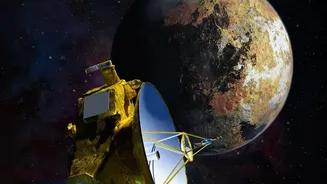
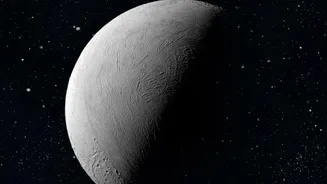
The evidence for cryovolcanism is a major clue pointing toward one of the most exciting possibilities on Pluto: a vast, subsurface ocean of liquid water. Tectonic features, like giant cracks and faults on Pluto's surface, are also consistent with the stresses caused by a slowly freezing and expanding ocean. Models based on data from the New Horizons flyby suggest this ocean could be more than 100 kilometres deep and may have a high salt content, similar to Earth's Dead Sea. While we can't see it directly, the combination of surface geology and thermal models makes a strong case that Pluto joins a growing list of icy worlds in our solar system, like Europa and Enceladus, that hide global oceans beneath their frozen crusts.
Landslides and a Changing Surface
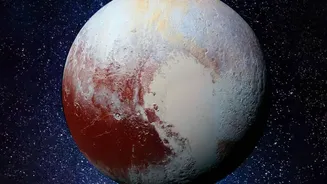
The signs of activity aren't limited to volcanoes. In 2026, scientists analysing high-resolution images from New Horizons identified the first evidence of massive landslides on Pluto. Six distinct landslides were found along the steep inner walls of impact craters near the famous heart-shaped region known as Sputnik Planitia. These debris aprons stretch for several kilometres, indicating that the displaced icy material moved very efficiently, likely due to Pluto's low gravity and low-friction surfaces. While the triggers for these landslides remain a mystery—possibilities include tectonic shifts or meteoroid impacts—they serve as another clear sign that Pluto's surface is not static but is actively being reshaped over geological time. More recent analysis also points to evidence that liquid nitrogen may occasionally flow up through cracks in the surface of the Sputnik Planitia glacier.
Why This Matters for Science
Pluto's surprising dynamism forces a complete rethink of how planetary bodies evolve. It demonstrates that a world doesn't need to be large or close to a star to remain geologically active for billions of years. This has profound implications for the search for life. If a small, frozen dwarf planet can hold onto enough internal heat to maintain a liquid water ocean, the number of potentially habitable environments in the universe could be far greater than previously imagined. Furthermore, some of the materials erupted from Pluto's cryovolcanoes appear to contain complex organic molecules, the chemical building blocks of life. While this doesn't mean there is life on Pluto, it suggests that the necessary ingredients for it could exist in the most unexpected and inhospitable corners of our solar system.