
Seeing the Invisible Universe
The secret to pulling back this cosmic curtain lies in infrared light. Unlike visible light, which our eyes can see, infrared light has longer wavelengths that can pass through dense clouds of interstellar gas and dust without being scattered or absorbed.
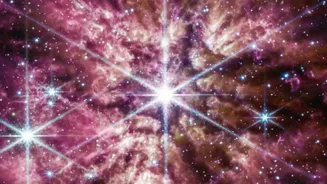
Think of it like trying to see through a smoky room; while your eyes struggle, a thermal camera can easily detect the heat of objects on the other side. In much the same way, infrared telescopes act as our cosmic thermal cameras. They detect the heat radiated by infant stars and warmed-up dust, allowing astronomers to see into the heart of stellar nurseries that appear as dark, empty patches to visible-light telescopes. This ability to bypass the dust is why space-based observatories like the James Webb Space Telescope (JWST) are optimized for infrared observation, giving us a front-row seat to the formation of stars.
Deep Fields and Stellar Nurseries
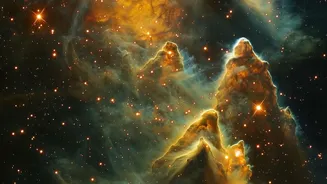
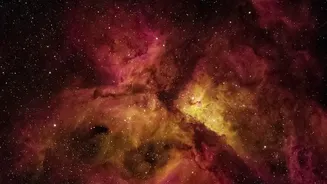
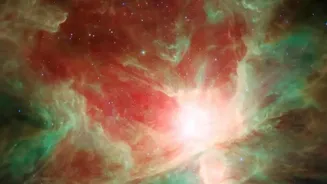
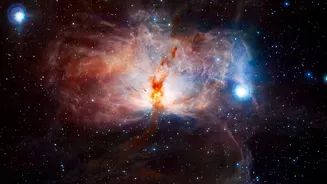
To capture these faint and distant events, astronomers use a technique called a deep field scan. This involves pointing a telescope at a single, seemingly empty patch of sky for hours or even days on end. By collecting light over such a long period, the telescope can reveal incredibly faint objects, from the universe's most ancient galaxies to the delicate structures of nearby nebulae. These nebulae, or giant molecular clouds, are the stellar nurseries of the cosmos. They are vast, cold clouds made of hydrogen gas and dust, spanning tens of light-years. While they look beautiful and serene in visible-light images from telescopes like Hubble, these pictures often miss the main event. Infrared deep fields reveal that these clouds are turbulent, clumpy, and chaotic environments where the next generation of stars is actively being born.
The Blueprint of a Star
So what do these infrared images actually show us? They reveal the entire process of star formation in stunning detail. It all begins when a dense clump within a molecular cloud starts to collapse under its own gravity. As the material falls inward, the core of the clump heats up, forming a protostar—an infant star that is still gathering mass from its parent cloud. This protostar is shrouded in so much dust that it's completely invisible in visible light, but it glows brightly in the infrared. As the protostar grows, it forms a rotating disc of gas and dust around its equator, known as a protoplanetary disk. This disk not only feeds the growing star but is also the raw material from which planets will eventually form. Infrared scans have been crucial in confirming that these disks are a common feature of star formation.
Cosmic Jets and New Discoveries
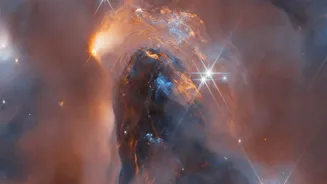
One of the most spectacular phenomena revealed by infrared scans are the powerful jets of gas and energy that shoot out from the poles of a young protostar. These jets, which can extend for light-years, are thought to be caused by magnetic fields and help regulate the star's growth by blasting away excess material. Recent observations from JWST have captured these jets with unprecedented clarity, showing intricate structures and wiggles that suggest some protostars may actually be binary systems of two stars orbiting each other. In regions like the Orion Nebula and the Serpens Nebula, these new scans are also helping scientists map the chemical ingredients present, including complex organic molecules and frozen water—key components for life as we know it. This allows researchers to catalog the raw materials available for building future planets and solar systems.