
Our Sun, A Volatile Star
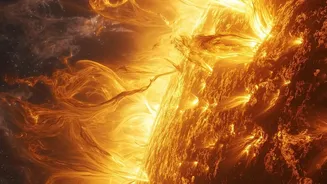
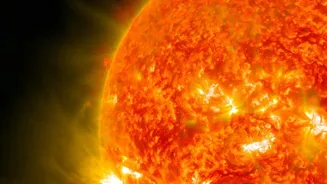
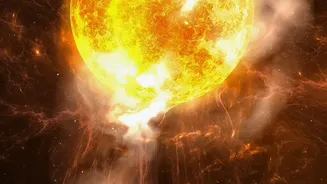
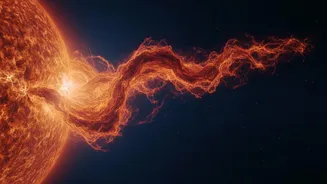
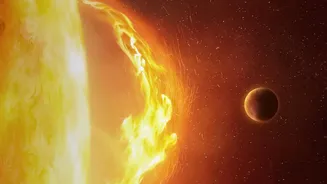
The sun, the star that powers life on Earth, has a turbulent nature. It frequently unleashes colossal bursts of energy and plasma, known as solar storms. These events, including solar flares and Coronal Mass Ejections (CMEs), send waves of charged particles
hurtling through space. While Earth's magnetic field, the magnetosphere, deflects most of these particles, exceptionally powerful storms can breach our natural shield. When that happens, the consequences can be severe. These storms can disrupt GPS navigation, interfere with radio communications used by aviation and shipping, and even damage critical satellites. On the ground, they can induce powerful electrical currents in power grids, potentially damaging transformers and causing widespread blackouts. As our society becomes more reliant on technology, our vulnerability to this space weather grows.
Aditya-L1: India's Front-Row Seat
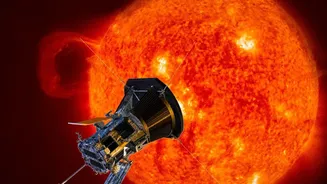
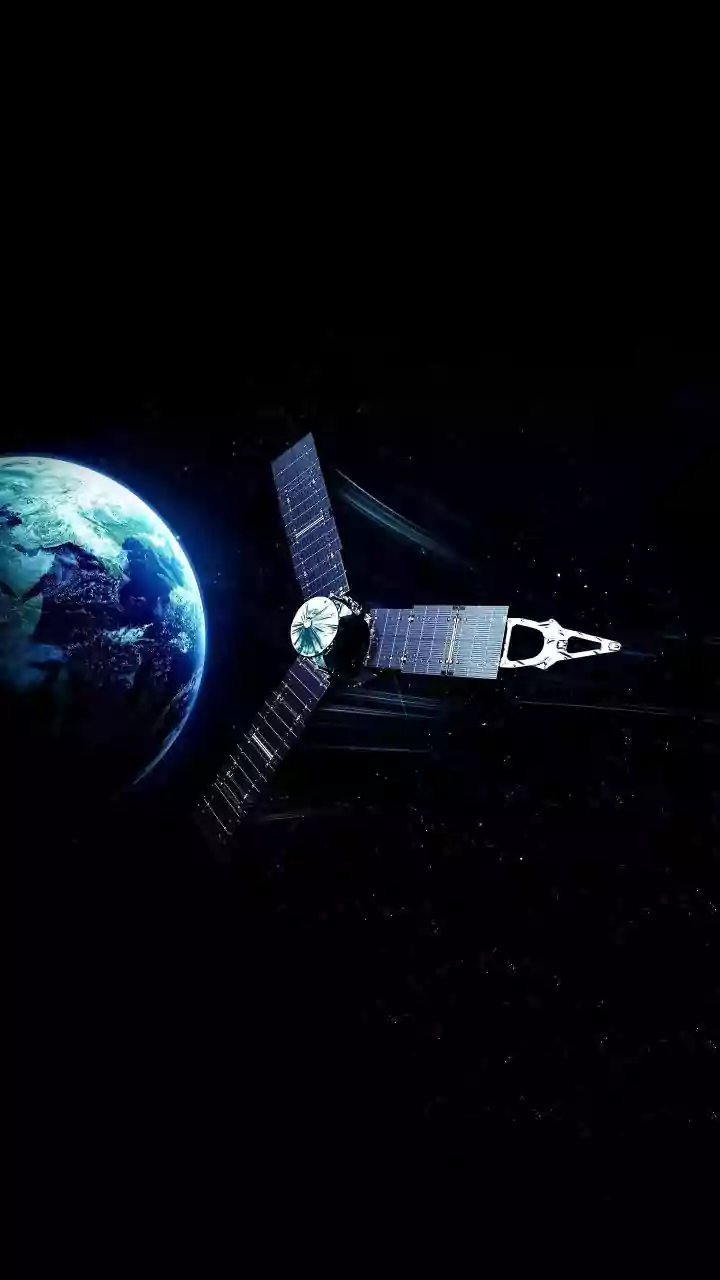
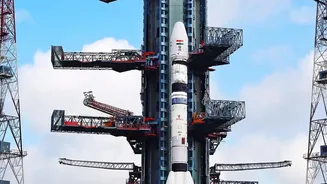
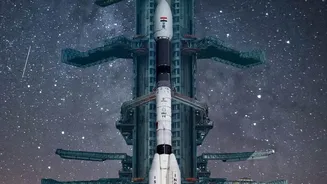
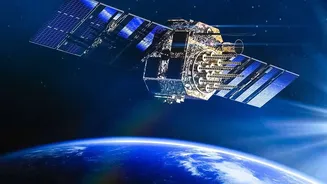
To better protect our technological infrastructure, the Indian Space Research Organisation (ISRO) launched its first dedicated solar observatory, Aditya-L1. The spacecraft is strategically positioned at Lagrange Point 1 (L1), about 1.5 million kilometres from Earth. This unique vantage point allows Aditya-L1 to have a continuous, uninterrupted view of the sun, free from the eclipses or distortions caused by Earth's atmosphere. This constant monitoring is the key to early detection. From its post at L1, the observatory can spot solar eruptions as they happen and measure the solar wind heading our way, providing a crucial warning time of 30 to 60 minutes before the storm impacts Earth. This lead time is vital for authorities and infrastructure operators to take protective measures.
The Power of a Clearer View
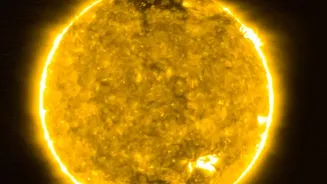
At the heart of Aditya-L1's mission are seven advanced scientific instruments, but two, in particular, are providing game-changing data on the sun's corona—the superheated outer atmosphere where solar storms are born. The Visible Emission Line Coronagraph (VELC) is the primary payload, designed to study CMEs right from their origin. It's an internally occulted coronagraph, meaning it creates an artificial eclipse to block the sun's bright disc, allowing it to see the much fainter corona extremely close to the solar limb—closer than most other space telescopes. This provides an unparalleled view of the initial lift-off of CMEs. It works in tandem with the Solar Ultraviolet Imaging Telescope (SUIT), which captures full-disk images of the sun in the near-ultraviolet range, a wavelength that was previously under-observed. Together, these instruments provide a more complete picture of the sun's atmospheric dynamics.
From Raw Data to Early Warnings
The new coronal data isn't just about pretty pictures; it's about providing actionable intelligence. By observing the corona with such clarity, scientists can identify the tell-tale signs of an impending eruption. Recent studies using Aditya-L1 data have identified tiny bursts of energy that act as precursors to major solar flares, similar to small tremors before a volcanic eruption. Furthermore, by capturing the spectroscopic signatures of a CME's onset phase, Aditya-L1 provides crucial information about the structure and energy of the eruption. Data from the VELC instrument, for instance, helps researchers measure the temperature, velocity, and magnetic field structure of the corona, all of which are critical factors in determining how a solar storm might evolve and impact Earth. This deeper understanding, combining direct observation with in-situ measurements of the solar wind, allows for more accurate and timely space weather models.
A New Era for Indian Space Science
The insights from Aditya-L1 are already proving invaluable. During major geomagnetic storms in 2024, data from the mission helped scientists understand why the events were so intense, revealing that a turbulent region within the storm strongly compressed Earth's magnetic field. These findings don't just advance science; they have direct, practical applications for protecting our national infrastructure. Better forecasting allows satellite operators to put their spacecraft into a protective 'safe mode', power grid managers to balance loads to prevent surges, and airlines to reroute flights away from polar regions where radiation exposure is higher during a storm. With Aditya-L1, India has transitioned from being a user of global space weather data to a key producer, cementing its role as a major player in space science and global safety.