




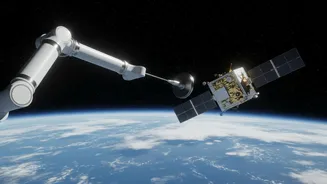
The Orbital Junkyard Problem
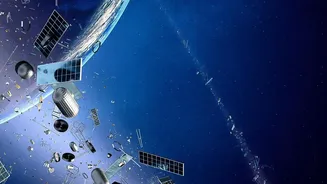
Low Earth Orbit (LEO) is becoming dangerously crowded. For decades, every rocket launch and satellite deployment has left something behind. This 'space junk' includes everything from defunct satellites and spent rocket stages to tiny flecks of paint and frozen
coolant. NASA tracks over 34,000 objects larger than a softball, but there are millions of smaller, untraceable fragments. Travelling at speeds up to 28,000 kilometres per hour, even a small piece of debris can strike an active satellite with catastrophic force. This poses a significant threat to the global infrastructure we depend on for GPS, communication, weather forecasting, and financial transactions. The situation is so critical that experts warn of the 'Kessler Syndrome,' a cascade of collisions where debris creates more debris, potentially rendering parts of orbit unusable for generations.
The Challenge of a Cosmic Cleanup
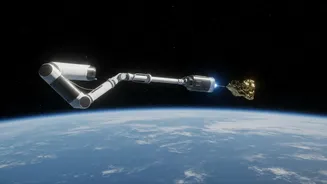
Cleaning up space is incredibly difficult and expensive. Traditional methods for removing debris often involve launching a dedicated spacecraft to capture and deorbit a single object, a process that requires huge amounts of propellant. These missions can cost upwards of $100 million for each piece of junk removed. Other concepts like nets and harpoons have been tested, but they risk creating even more debris if the capture is not perfectly executed. The sheer cost and complexity have made large-scale cleanup efforts economically unviable, forcing space agencies to focus more on mitigating the creation of new debris rather than removing what is already there. What has been missing is a reusable, efficient, and cost-effective way to grab multiple pieces of junk on a single mission.
How Magnetic Tethers Work
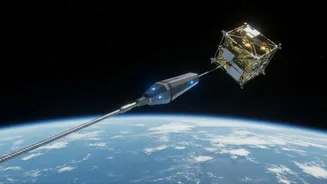
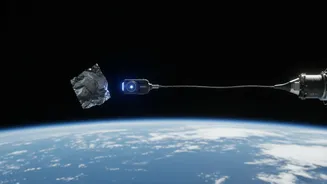
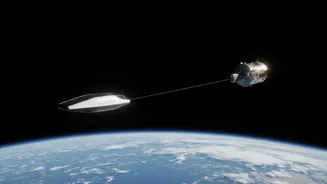
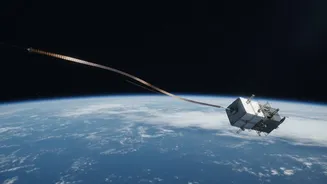
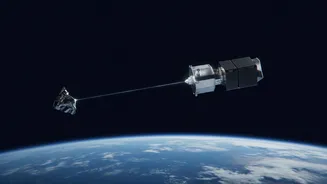
Magnetic and electrodynamic tethers represent a revolutionary approach. Instead of a physical robotic arm, these systems use electromagnetic forces. One common type, the electrodynamic tether, is a long, conductive wire, sometimes several kilometres long, that is deployed from a 'tug' satellite. As this tether moves through the Earth's magnetic field, it naturally generates an electric current. This interaction creates a force called Lorentz drag, which acts as a brake, slowing the satellite and any attached debris down without using any propellant. The debris is then guided into a lower orbit where it safely burns up in the atmosphere. Magnetic tethers, a related concept, use powerful magnetic fields to attract and latch onto metallic debris, offering a contact-free method of capture before the deorbiting process begins.
A Breakthrough Demonstration
While the headline points to a recent demonstration, the technology builds on years of research. For example, Japan's space agency, JAXA, has been a key player, previously testing concepts like the Kounotori Integrated Tether Experiment (KITE). More recent demonstrations, such as those by private companies like Astroscale, have successfully validated the ability of a servicer satellite to repeatedly capture simulated debris using magnetic docking plates. These tests prove the core principles of the technology in a real orbital environment. The E.T.PACK-Fly project, another key initiative, is also developing a lightweight, autonomous deorbiting device using an electrodynamic tether, with demonstrations planned to showcase its proficiency. These successful tests are critical steps toward proving the technology is ready for commercial application.
The Efficiency of a Fuel-Free Solution
The efficiency of magnetic and electrodynamic tethers comes from one key advantage: they don't require propellant for deorbiting. This dramatically reduces mission cost and complexity. A traditional mission's weight is dominated by fuel, which must be launched into orbit at great expense. By harnessing the Earth's own magnetic field, a tether-based tug can perform multiple deorbit manoeuvres on a single mission, moving from one piece of debris to the next. This 'multi-target' capability transforms the economics of debris removal. Analyses have shown that electromagnetic systems can reduce removal costs by 90-95% compared to conventional methods. Furthermore, magnetic capture avoids the risks of kinetic impact from harpoons or nets, which can create secondary fragments. It is a cleaner, safer, and ultimately more sustainable way to clean up our orbital highways.
The Road Ahead for Orbital Services
The successful demonstrations of magnetic tether technology are paving the way for a new commercial industry focused on 'on-orbit servicing.' Companies are now developing 'space tugs' that can not only remove debris but also service, refuel, and reposition active satellites. Astroscale's ELSA-M mission, set to launch in 2026, aims to remove multiple defunct satellites in a single mission. These advancements are moving from theoretical concepts to practical, commercially viable solutions. By making debris removal affordable, this technology doesn't just clean up the past; it ensures the future of the nearly $500 billion space economy and protects the vital infrastructure that orbits above us.