







The Deluge in Our Cities
Urban flooding has become a chronic problem across India. Unplanned development, disappearing wetlands, and overwhelmed colonial-era drainage systems have created a perfect storm. When intense rainfall hits, as it does with increasing frequency due to climate
change, water has nowhere to go. Streets become rivers, homes are inundated, and economic life grinds to a halt. For years, the solution was thought to be on the surface: better drains, more green spaces, and reviving water bodies. These are all crucial, but as extreme weather events become the norm, experts agree that surface-level solutions alone may not be enough. The search is on for more radical ideas, and that search is leading planners to look deep beneath the city streets.
An Underground Liability
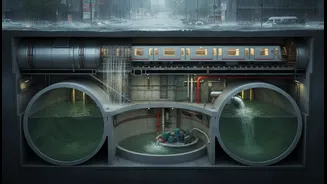
Our underground spaces, particularly metro systems, are currently part of the problem. During a downpour, they are highly vulnerable. The ventilation grates you see on sidewalks, designed to allow air in and out of the tunnels, become perfect entry points for floodwater. In cities like New York, storms have caused catastrophic flooding in the subway system through these very openings. After Hurricane Sandy, the city spent millions installing flood-proof gates and raising ventilation shafts to prevent a repeat. This highlights a key issue: our existing underground infrastructure is designed to keep water out, turning it into a fortress to be defended rather than an asset to be used.
The Real Solution: Tunnels as Sponges
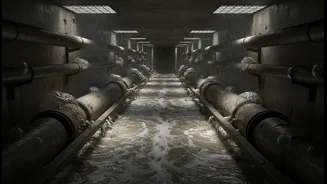
The headline's idea of using 'ventilation' to suck up water is a slight simplification. The actual, more powerful concept engineers are implementing is not about air, but about volume. Cities are now building massive underground networks of 'deep tunnels' designed specifically to act as giant reservoirs for stormwater. During a cloudburst, excess rainwater is diverted from the surface into these enormous tunnels, some many metres in diameter. The water is held there until the storm passes and the main drainage system has capacity again. Then, it is slowly released and sent to treatment plants. This frees up valuable land on the surface that would otherwise be needed for detention ponds and doesn't compete with buildings or parks.
Lessons from Chicago and Tokyo
This isn't science fiction; it's already happening. Tokyo has a world-famous system, the G-Cans project, featuring a colossal underground tank often called the 'underground temple' for its sheer scale. Closer to home in terms of urban layout, Chicago's Tunnel and Reservoir Plan (TARP) is a pioneering example. For decades, this system of deep, large-diameter tunnels has been capturing storm overflow. Just this month, in July 2026, Chicago officials unveiled a new pilot project with smaller underground storage tanks to provide targeted flood relief to specific neighbourhoods, showing how the concept can be scaled down. These projects prove that using subterranean space to manage floods is a viable, albeit expensive, strategy.
The Challenge for Indian Cities
So, could this work in India? The challenges are immense. The cost is the most obvious hurdle; these are multi-billion dollar projects. But the bigger problem is complexity. Retrofitting such a system into a densely packed and often chaotically developed city like Mumbai or Bengaluru is an engineering nightmare. You would have to navigate a subterranean maze of existing utilities, building foundations, and complex geological conditions. However, the principle of creating underground holding capacity could be adapted. Newer developments and 'smart cities' could incorporate smaller, localised storage tunnels from the start. For existing metros, while they can't become flood channels, ensuring they are protected from inundation is a critical first step toward overall resilience.