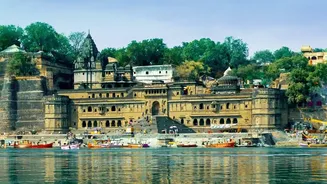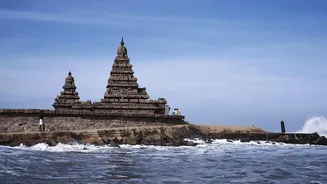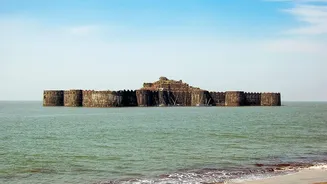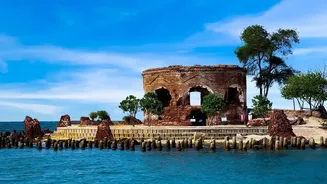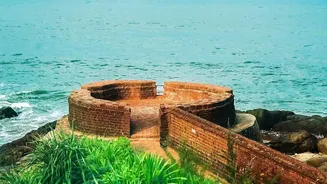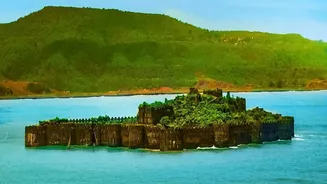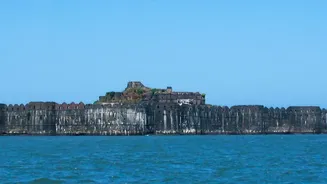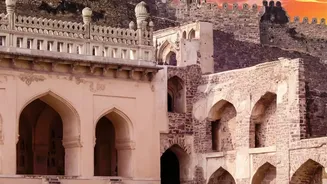








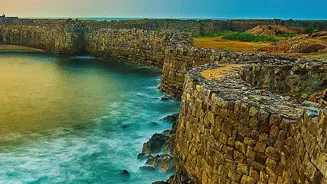

Perched on rocky islands along Maharashtra's coast, sea forts stand as powerful sentinels of history. These magnificent structures have weathered sieges and the sea for centuries, but now face a silent, relentless battle against time and neglect.
The Unconquered Sentinel: Murud-Janjira
Among
the many jewels of the Konkan coast, the Murud-Janjira fort holds a special place. Rising from an oval-shaped rock in the Arabian Sea, its 40-foot-high walls seem to emerge directly from the water, a formidable sight that has intimidated enemies for centuries. Originally a small wooden structure built by local fishermen in the 15th century to defend against pirates, it was transformed into an impregnable stone fortress by Malik Ambar of the Ahmadnagar Sultanate around 1567. Its name, a combination of the Arabic word 'Jazira' for island and the local word 'Murud', speaks to its unique geography. For centuries, this fort was the stronghold of the Siddis, rulers of African origin who established a powerful naval base here. What makes Janjira legendary is its unconquered status; it repelled numerous attacks from naval powers including the Portuguese, the British, and even the formidable Marathas under Chhatrapati Shivaji Maharaj and his son, Sambhaji.
An Architectural Marvel of Defence
The genius of Murud-Janjira lies in its defensive architecture. The main gate is cleverly hidden and only becomes visible at close range, a feature designed to confuse and trap invaders. The fort once boasted over 500 cannons; today, a few massive ones like 'Kalaal Baangadi' remain, silent reminders of its former firepower. The structure is a self-contained world. Remarkably, despite being surrounded by the saline Arabian Sea, the fort contains two natural freshwater lakes, which ensured a sustainable water supply for its inhabitants during long sieges. Inside its walls lie the ruins of palaces, officers' quarters, and a mosque, hinting at the bustling life it once supported. This blend of strategic location, ingenious design, and self-sufficiency is what made Janjira the unconquerable bastion it was.
The Silent Siege of Time and Neglect
Today, Maharashtra's sea forts face threats more insidious than any cannonball. The same sea that protected them now relentlessly chips away at their foundations with saline winds and powerful monsoon waves. These natural forces are compounded by human neglect. Many of India's historical monuments, particularly those that are not as famous as the Taj Mahal or Red Fort, suffer from a lack of adequate funding and attention. Challenges include urban encroachment, environmental degradation, and sometimes, the sheer scale of the preservation task itself. The Archaeological Survey of India (ASI), the primary body responsible for these sites, often faces staff shortages and bureaucratic hurdles. As a result, many magnificent structures are slowly crumbling, their stories fading with each falling stone.
Why We Must Preserve These Sentinels
Preserving these forts is not merely about protecting old buildings; it is about safeguarding the tangible soul of a region's history. These structures are irreplaceable chronicles of engineering, military strategy, and human resilience. For Maharashtra, they are powerful symbols of the Maratha naval legacy and the diverse history of the Konkan coast. They are also significant economic assets, with the potential to drive heritage tourism that can support local communities. Recognizing this, efforts are underway to better protect these sites. The Maharashtra government has pushed for the inclusion of 12 forts, including sea forts like Sindhudurg and Vijaydurg, in the UNESCO World Heritage list under the 'Maratha Military Landscapes of India' theme. This push for recognition brings with it comprehensive management plans for conservation, visitor management, and community engagement. Such initiatives are vital because these forts are more than monuments; they are classrooms of history, pillars of cultural identity, and an inspiration for future generations.