

A Famous Solar Puzzle
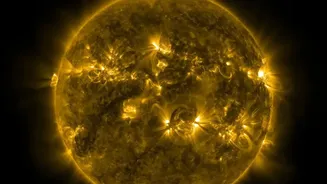
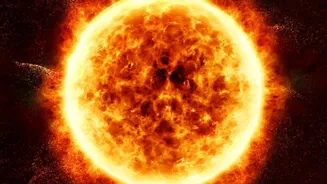
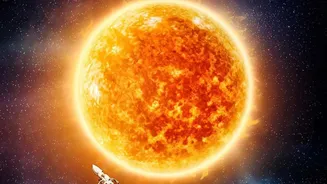
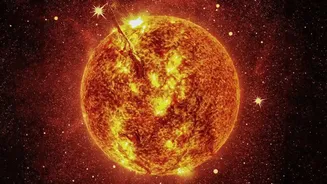
Imagine a fire that is hotter a few feet away than it is at its source. This is the baffling situation with our sun. Its visible surface, the photosphere, sizzles at around 5,500 degrees Celsius. Logic suggests that the further away you get, the cooler
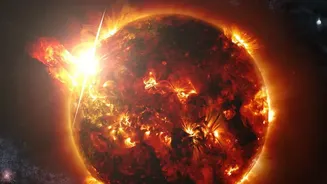
it should be. Yet the sun's outer atmosphere, the corona, blazes at an astonishing 1 to 2 million degrees Celsius. This phenomenon, known as the coronal heating problem, has puzzled astrophysicists for over 70 years. The laws of physics dictate that heat cannot flow from a cooler object to a hotter one, so some non-thermal process must be carrying immense energy from the sun's surface and depositing it in the corona, superheating it. Scientists have long suspected the sun's complex magnetic fields were involved, but the exact mechanism has remained elusive.
What Did Scientists Actually See?
Using the world's largest and most powerful solar observatory, the Daniel K. Inouye Solar Telescope in Hawaii, scientists have captured the highest-resolution images of the sun’s surface to date. These unprecedented pictures revealed tiny, swirling vortices of plasma at the edges of solar granules—the bubbling patterns of hot gas that cover the sun. Some of these whirlpool-like structures, barely 20 kilometres across, show the tell-tale signs of a process called Kelvin-Helmholtz instability (KHI). This instability occurs when two fluids, or in this case plasmas, flow past each other at different speeds, creating a shear that curls into waves and vortices, much like wind blowing over water. This is the first time this fundamental fluid dynamic process has been directly observed on the sun's surface.
A 'Smoking Gun' for Energy Transfer
The discovery of these tiny plasma swirls is more than just a remarkable feat of observation; it is a potential 'smoking gun' for the coronal heating mystery. These Kelvin-Helmholtz instabilities are a sign of intense energy transfer. As the plasma swirls and twists, it also twists the magnetic field lines that are rooted in the sun's surface and extend up into the corona. This twisting motion builds up magnetic energy, similar to winding up a spring. This stored energy can then be transported upwards along the magnetic field lines. Scientists believe this process can generate different kinds of magnetic waves, such as Alfvén waves, which travel up into the corona before releasing their energy and heating the sparse plasma to incredible temperatures. In essence, these tiny vortices act as motors, constantly churning and injecting energy into the solar atmosphere.
Why This Matters for Us on Earth
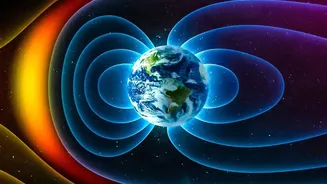
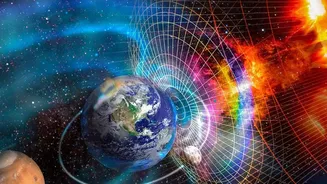
Understanding the fundamental processes that drive our sun is not just an academic exercise. The same mechanisms that heat the corona also fuel explosive solar events like flares and coronal mass ejections (CMEs). These powerful eruptions launch vast clouds of charged particles into space. When directed at Earth, this 'space weather' can have serious consequences. It can disrupt satellite communications, damage power grids, and even pose a risk to astronauts. By understanding the root causes of this activity—starting with these tiny, newly-observed plasma waves—scientists can improve their models for predicting space weather. Better forecasting would give us more time to protect our increasingly technology-dependent society from the sun's most violent outbursts.