






Why Your Posture Is the Starting Line
Think of your posture as the gateway to your practice. If your body is sending constant signals of pain or strain, your mind will be pulled away from your breath. The goal is not to achieve a perfect, rigid pose, but to find a sustainable position of stability
and ease—what ancient yogis called 'sthira' (steady) and 'sukham' (comfortable). An aligned posture also directly enables better breathing. A slumped chest restricts the movement of the diaphragm, the primary muscle for deep, calming breaths. By sitting in a way that is upright yet relaxed, you create the physical space necessary for your mind to settle.
The Golden Rule: Hips Higher Than Knees
This single adjustment solves most common sitting pains. When you sit flat on the floor, your pelvis tends to tilt backward, causing your lower back to round. To compensate, your upper back and neck slump forward, and soon, your muscles are working overtime just to hold you up. By elevating your hips on a firm cushion, folded blanket, or meditation bench, you allow the pelvis to tilt naturally forward. This restores the natural curve in your lower back, letting your spine stack itself without muscular strain. Whether you sit cross-legged, kneeling, or in a chair, this principle is the key to effortless alignment.
Finding Your Seat: Chair, Cushion, or Bench
There is no 'correct' way to sit; there is only the way that works for your body. For many people, especially beginners, a chair is the best option. To use a chair effectively, sit toward the front edge with your feet flat on the floor, creating a stable base. This keeps your spine upright without leaning on the backrest. If you prefer the floor, a round cushion (zafu) or a firm, folded blanket provides the necessary lift for your hips. If cross-legged positions are difficult, a kneeling meditation bench supports your weight while keeping your spine straight without pressure on your knees or ankles.
Aligning the Details for Deeper Ease
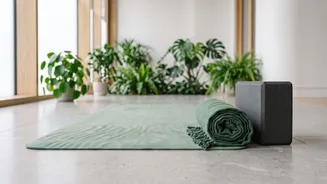
Once you have your foundation, fine-tune the details. Let your shoulders drop down and away from your ears, opening up your chest. Allow your hands to rest comfortably in your lap or on your thighs. Tuck your chin slightly, as if a string were gently lifting the crown of your head toward the ceiling, which helps align your neck with your spine. If you're sitting cross-legged and your knees are hovering in the air, slide blocks or pillows underneath them for support. This prevents strain on your hip joints and allows for a deeper release into the posture.
A Simple Breath-Awareness Practice
Now that you're comfortable, you can turn your attention to the breath. Close your eyes or soften your gaze. Begin by simply noticing the sensation of breath where you feel it most vividly—perhaps as cool air at the nostrils or the gentle rise and fall of your abdomen. Don't try to change your breathing; just observe it as it is. When you notice your mind has wandered—and it will—gently and without judgment, guide your attention back to the breath. This act of returning is the core of the practice. Start with just five minutes.