



An Orbital Junkyard
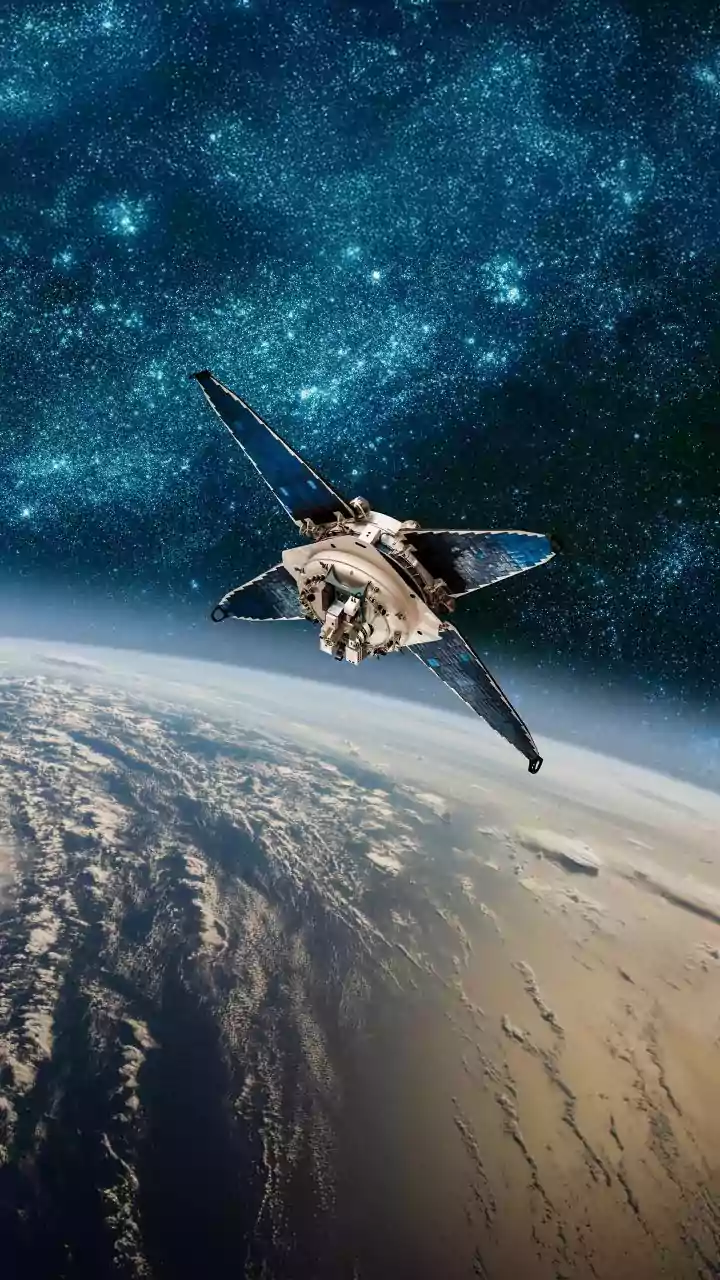
Since the dawn of the space age, we've been leaving things behind. Low Earth Orbit (LEO) is now home to an estimated 8,000 metric tons of debris. This includes everything from spent rocket stages and defunct satellites to millions of smaller fragments
from past collisions. These objects travel at speeds up to 28,000 kilometers per hour, where even a tiny paint chip can strike with the force of a hand grenade, disabling a critical satellite. Experts warn of a potential "Kessler Syndrome," a chain reaction of collisions where the debris cloud becomes so dense it could render LEO unusable for generations. This poses a direct threat to the satellite infrastructure that underpins global communications, weather forecasting, and navigation systems.
Enter the Harpoon
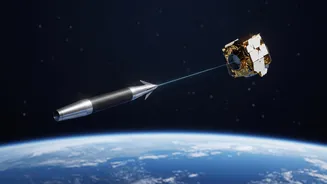
To combat this threat, agencies like the European Space Agency (ESA) are exploring a surprisingly ancient tool: the harpoon. The concept is straightforward: a specialized 'chaser' spacecraft would approach a large, tumbling piece of debris, such as a defunct, multi-tonne satellite. From a safe distance, it would fire a tethered harpoon into the target. Once the harpoon penetrates the target's hull, barbs would deploy to secure the grip, allowing the chaser to either pull the junk into a stable configuration or drag it out of orbit to burn up in the atmosphere. The RemoveDEBRIS mission, led by the Surrey Space Centre and co-funded by the European Union, successfully tested a harpoon in orbit, proving the fundamental viability of the concept.
Clarifying the 'Laser' Part
The headline's term "laser harpoon" can be slightly misleading, as it often merges two distinct technologies. While physical harpoons are one method, lasers represent another. One approach is called laser ablation. In this scenario, a powerful ground-based or space-based laser fires pulses at a piece of debris. The intense energy doesn't vaporize the entire object but rather a tiny part of its surface, creating a small jet of plasma. This plasma plume acts like a micro-thruster, gently nudging the debris into a new, lower orbit where it will eventually re-enter and burn up in the atmosphere. This "laser broom" method is seen as a cost-effective way to handle the millions of smaller, untrackable pieces of junk. Lasers are also critical for the harpoon missions, but they are used for targeting, with LiDAR systems providing the precise navigation and distance-ranging needed to track and capture a tumbling object.
The Commercial Cleanup Crew
Cleaning up space is not just a job for government agencies. A new market for in-orbit services is emerging, with several startups developing innovative solutions. Companies like Japan's Astroscale and Switzerland's ClearSpace are pioneering missions to remove debris. ClearSpace was contracted by ESA for the world's first active debris removal mission, aiming to capture and deorbit a piece of a Vega rocket. Meanwhile, firms like Portal Space Systems and Paladin Space are partnering to create a commercial "Debris Removal as a Service" model, hoping to make cleanup operational rather than experimental. These companies are developing everything from robotic capture arms and nets to advanced AI for tracking and autonomous rendezvous.
Challenges on the Final Frontier
Despite the promising technology, active debris removal faces significant hurdles. The technical challenges are immense, requiring precision robotics and autonomous control systems that are still in development. A failed capture attempt could be catastrophic, potentially breaking a large piece of debris into thousands of smaller, more dangerous ones. Beyond the technical, there are complex legal and economic questions. Who is responsible for old satellites? Who pays for the cleanup? An international consensus is needed to create the policies and incentives that will encourage debris removal and prevent the creation of new junk. Many experts advocate for regulations requiring all new satellites to have a plan for deorbiting at the end of their life, ensuring we don't keep adding to the problem.