




A Universe of Data
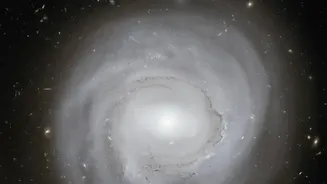
Modern astronomy is a victim of its own success. Telescopes like the Hubble, the James Webb Space Telescope, and ground-based observatories produce an overwhelming flood of information every single day. These instruments have collected decades of observations,
amounting to over 150 petabytes of data—an archive so vast that traditional methods of analysis are no longer sufficient. For scientists, manually sifting through this digital haystack to find a needle of cosmic significance is an impossible task. This data deluge means that countless discoveries may be lying dormant in NASA's own archives, simply waiting for a tool powerful enough to uncover them.
The Rise of the AI Astronomer
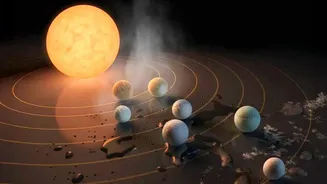
In response, NASA has been developing and deploying a suite of artificial intelligence programs designed to act as tireless research assistants. These aren't just simple algorithms; they are sophisticated foundation models, similar in concept to the technology behind large language models. Projects with names like ExoMiner, Prithvi, and Surya have been trained on immense, curated datasets from past missions. For example, the ExoMiner system was fed data from the Kepler Space Telescope and successfully identified 301 new exoplanets that had previously been missed. More recently, an AI system called RAVEN analysed data from the TESS mission to confirm over 100 exoplanets, including 31 entirely new worlds.
How to Train a Cosmic Detective
Training these AI models is a meticulous process. Scientists feed them vast libraries of classified objects—millions of examples of stars, galaxies, supernovae, and black holes. The AI learns to recognise the subtle patterns, light curves, and spectral signatures associated with each type of phenomenon. Once trained, it can scan new, unanalysed data at incredible speeds, flagging anything that matches its training or, more excitingly, deviates from it. This ability to spot anomalies is crucial for discovery. The AI can identify unusual signals that a human researcher, scanning for specific targets, might overlook. This approach has already helped scientists pinpoint rare events and strange objects like planets in the 'Neptunian desert', a region of space where they were thought to be scarce.
A New Human-AI Partnership
This technology is not about replacing human astronomers, but augmenting them. The role of the researcher is shifting from the monotonous task of data sifting to the more creative and critical work of interpretation and investigation. The AI handles the heavy lifting, presenting scientists with a curated list of interesting candidates for further study. NASA's framework often involves a 'human-in-the-loop' approach, where experts validate the AI's findings, correct its mistakes, and provide feedback to make the system smarter over time. This collaborative cycle ensures that human expertise guides the discovery process, while AI provides the speed and scale needed to tackle modern datasets. It transforms the scientific method into a dynamic partnership between human intellect and machine efficiency.
Redefining the Pace of Discovery
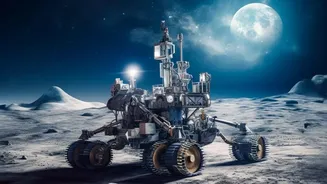
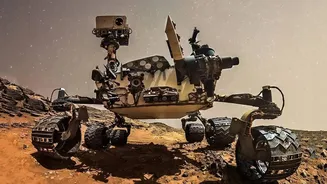
The implications of this shift are profound. Questions that might have taken decades to answer could now be explored in a fraction of the time. With AI, scientists can more accurately predict cosmic events like solar flares, analyse gravitational waves, and even automate the navigation of rovers on Mars. NASA is now building foundation models for nearly every branch of its science, from heliophysics to lunar exploration. As telescopes become even more powerful, this reliance on AI will only grow. It represents a fundamental change in how we explore the cosmos, accelerating the pace of discovery and promising to unlock secrets of the universe that have long been hidden in plain sight.